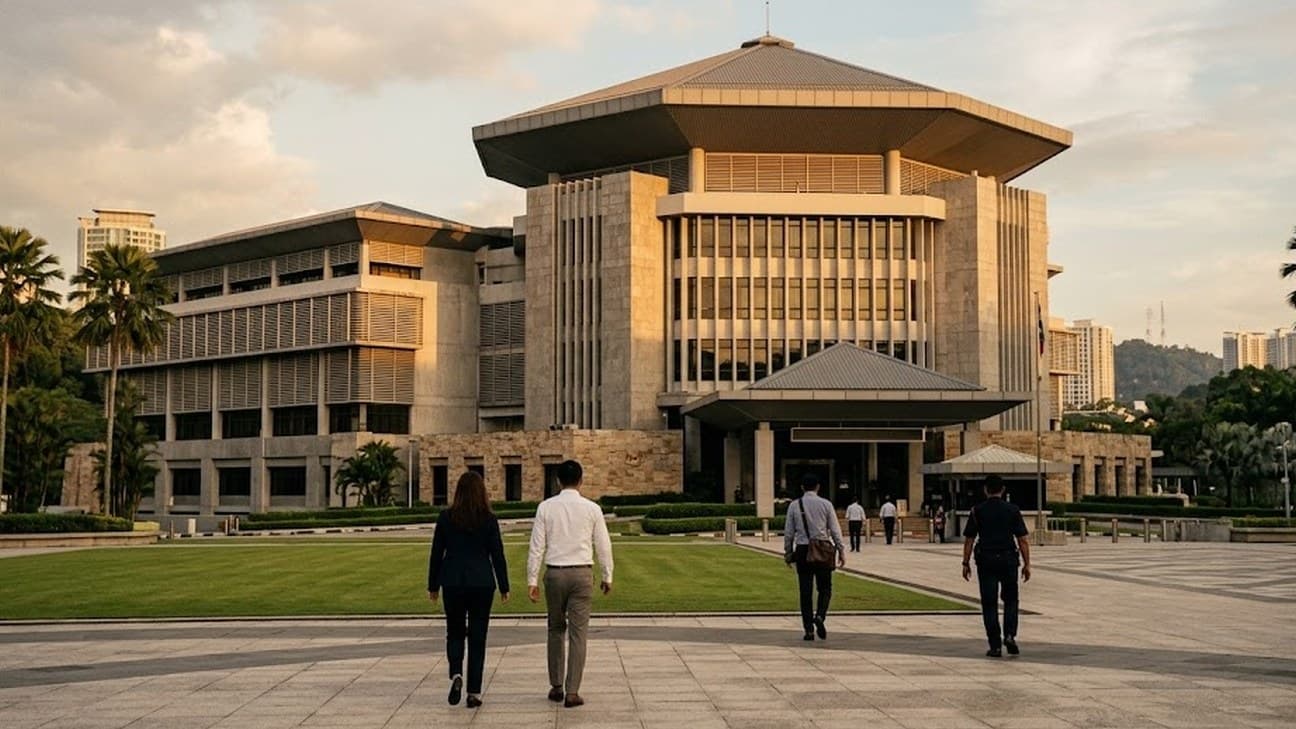
Malaysia's Record Investment Wave Is Real — But It Is Narrowing Onto Chips, AI and Data Centres, and Economists Are Flagging the Concentration
Malaysia has spent the past three years absorbing an investment boom that, on the headline numbers, looks unambiguous. According to an analysis published by The Star on July 30, the country averaged RM352.1 billion in approved investments annually across 2022–2025, and added a further RM92.8 billion in the first quarter of 2026 alone. The piece credits a specific stack of drivers: geoeconomic fragmentation and supply-chain reconfiguration, the China Plus One diversification strategy, the National Semiconductor Strategy, the New Industrial Master Plan 2030, the Economy Madani framework, and a pipeline of digital, AI and data-centre projects concentrated in Johor.
The more useful signal is not the total but its shape. Lee Heng Guie, executive director of the Socio-Economic Research Centre, frames Malaysia as "one of the investment destinations under the China Plus One strategy for foreign investors seeking to diversify their investment risks" — a positioning that has genuinely delivered capital. But Alvin Desfiandi, chief economist at the Centre for Market Education, supplies the caution that matters for allocators: "Future gains are more likely to come from continued execution and a broader project pipeline than from another burst of headline-sized mega deals." In other words, the record inflows have been powered by a small number of very large, capital-intensive projects — precisely the semiconductor fabs, cloud regions and data-centre campuses that dominate the announcement flow — and the durability of the trend now depends on execution and breadth, not on repeating those one-off deals.
That concentration is exactly what makes this a weekly story rather than a restatement of a growth statistic. The daily coverage this month has tracked the constraints piling up around that same buildout — a financing gap domestic banks cannot bridge, an OECD warning that the data-centre wave is generating growth but few jobs while straining power and water, and a national AI workforce sitting at a fraction of its 2030 target. The RM352 billion figure is the other side of that ledger: it shows the capital is arriving in force, but arriving into a narrow band of the economy whose absorptive limits — grid, labour, financing — are the very things now being tested.
A Philippine Universal Bank Puts Stablecoins Into Its Own Remittance Stack — BPI's Cross-Border Pilot With Meridian
The most concrete digital-asset development in the region this week did not come from an exchange or a regulator, but from a bank. Bank of the Philippine Islands — one of the country's largest universal banks — has begun piloting a cross-border settlement system with Meridian, a global digital clearinghouse, that uses stablecoins as the intermediary settlement instrument, converting into Philippine pesos before funds are credited to a recipient's account. The initial use case is inbound payroll for informal-economy workers: freelancers, virtual assistants and overseas Filipino workers receiving income from abroad.
The framing from the top of the bank is deliberately mundane, which is the point. Chief executive TG Limcaoco described the goal in plain remittance terms — "Filipinos move billions of pesos every year, and it is our responsibility to make sure that their money arrives faster, cheaper, and just as securely as it does today." The pilot runs under existing Bangko Sentral ng Pilipinas frameworks rather than a new licence or sandbox, and BPI has signalled it intends to broaden access to more client segments before the 49th ASEAN Summit that the Philippines hosts in November. Stablecoin conversion is not itself new to the market — Coins.ph and PDAX already offer it, and Cebuana Lhuillier is building Solana-based stablecoin rails with Fireblocks — but those are crypto-native or remittance-specialist venues. BPI is a systemically important bank routing a mainstream product over the same rails.
That distinction is the story. When stablecoin settlement moves from a crypto exchange's balance sheet into a universal bank's payments product, it stops being a workaround for the underbanked and becomes part of the regulated financial plumbing — with the bank's own compliance, reserve-transparency and consumer-protection obligations attached. For a country where cross-border remittances are a macro-scale flow, a large bank demonstrating that stablecoins can shave cost and settlement time off inbound payroll is a materially different proof point than another exchange offering on-ramp conversion.
Indonesia Takes Its Data-Centre Ambitions Straight to Chinese Capital — a US$1.83 Billion Pitch to 27 Enterprises in Jakarta
While Malaysia's data-centre buildout runs into its financing and grid ceilings, Indonesia spent this week openly competing for the capital. At the Indonesia-China Partnership Forum in Jakarta on July 23, Andi Maulana, a deputy for investment services at Indonesia's Investment and Downstreaming Ministry, pitched the country's data-centre sector directly to representatives of 27 Chinese enterprises. The market, he told them, is projected to reach US$1.83 billion in 2026 — up from US$1.44 billion in 2025 — and to grow to US$3.48 billion by 2031, a compound annual growth rate of 13.71%.
The pitch was structured as an investment-facilitation offer, not a vision statement. Maulana pointed to 25 special economic zones, 181 industrial estates, and the Direct Construction Investment Facilitation (KLIK) programme as ready-built channels for foreign capital to deploy quickly, alongside tax incentives. He anchored the ask in an existing relationship — citing US$38.34 billion of Chinese investment into Indonesia between 2021 and mid-2026 — and in the scale of the prize, referencing projections that Indonesia's digital economy could reach US$180–340 billion in gross merchandise value by 2030. The framing was explicit: data-centre development is, in his words, "a very promising investment opportunity."
The geopolitics under the pitch are worth naming precisely. Courting Chinese data-centre capital sits in tension with the US-origin compliance regime now shaping GPU access across the region — the same end-user and ownership scrutiny that has tightened who can actually take delivery of advanced chips in Singapore, Malaysia and Japan. Indonesia is betting that a large domestic market, ready-made zones and cheaper factor costs can attract Chinese builders even where the highest-end accelerators may be hard to source, positioning itself for the compute demand that Malaysia's grid and approvals cannot immediately absorb. Whether that capital can be paired with compliant chips is the open question the pitch does not answer.
Manila Moves on Open Finance: a Bill to Turn E-Wallet and Utility Data Into Credit Access
The Philippines produced a second, quieter fintech signal this week on the policy side. On July 28, House Bill 9149 — the "Open Finance and Consumer Data Empowerment Act," co-authored by Tingog Party-list Representative Jude Acidre — was reported as seeking to let consumers authorise financial institutions to access up to 24 months of their transactional data for credit evaluation. Crucially, that data explicitly includes non-bank sources: e-wallet transactions, utility-bill payments, subscription records and rewards-card activity, allowing lenders to assess creditworthiness for borrowers who have no traditional banking relationship.
The bill would build institutional scaffolding around the idea rather than leaving it to voluntary industry practice. It proposes a Consumer Data Commission under the Office of the President, chaired by a Securities and Exchange Commission commissioner and co-chaired by a Bangko Sentral ng Pilipinas deputy governor, with members drawn from the National Privacy Commission, National Telecommunications Commission and Philippine Competition Commission, plus four private-sector experts. The commission's remit would cover security standards, accreditation of data-receiving entities, compliance audits, penalties, annual reports to Congress and a review of the law every two years. The economic case rests on scale: digital payments accounted for 57.4% of retail transactions in 2024, and roughly 58 million Filipinos now use e-wallets, generating exactly the alternative-data trail the bill would put to work.
It is important to be precise about status: this is a filed bill, not a law, and it will move through the legislative process before any of it binds. But it signals the direction of Philippine fintech policy — toward consented data portability as the engine of credit inclusion — and it arrives with backing from industry, including Todd Schweitzer of the Fintech Alliance Philippines. Read alongside the BPI stablecoin pilot, it sketches a coherent national posture: use regulated rails and consented data to bring the informal economy into formal finance.
Eyes on the Week Ahead
The near-term calendar keeps the placement-of-capital theme running. In the Philippines, watch whether BPI's stablecoin pilot broadens beyond inbound payroll ahead of the 49th ASEAN Summit in November, and whether House Bill 9149 clears its early committee stages with any Bangko Sentral endorsement attached — both would confirm Manila's move toward regulated rails and consented data as the spine of financial inclusion. In Indonesia, the test is whether Jakarta's Chinese-capital data-centre pitch converts into signed commitments, and how those projects square their financing with export-compliant chip access.
On the Malaysia side, the signal to track is breadth in the investment pipeline: after a record three-year run concentrated in semiconductors, AI and data centres, the question flagged by economists this week is whether the next quarter's approvals spread across more states and mid-sized projects or cluster again around a few mega-deals. Watch too for any Securities Commission or Bank Negara Malaysia signalling on the promised end-2026 clarity for ringgit stablecoins and tokenised deposits — the regulatory counterpart to the private-sector stablecoin moves now appearing across the region.
Layer 7 Ventures is a research-driven firm focused on AI and cryptocurrency in Southeast Asia. Views expressed are those of the firm and do not constitute investment advice.