All reports
Daily Brief · Geopolitics · FinTech

SEA Daily Brief: Fitch's Thailand Upgrade, Moody's AI Growth Cushion, and Malaysia's Digital-Currency-Bullish Treasurers

Fitch Ratings revised Thailand's sovereign outlook from Negative to Stable, affirming the BBB+ rating on debt stabilization and political continuity under the Anutin coalition. Moody's separately flagged an AI-driven export and data-centre investment boom as the region's main cushion against tariff and energy shocks, projecting ASEAN growth easing only modestly to 4.8% in 2026. And an HSBC treasury survey found Malaysian finance professionals are the most bullish adopters of digital currencies in Asia-Pacific, even as most admit their own treasury functions are lagging the technology.

September 19, 20264 min readThailand · Malaysia · ASEAN · AI · Macro · Digital Currency
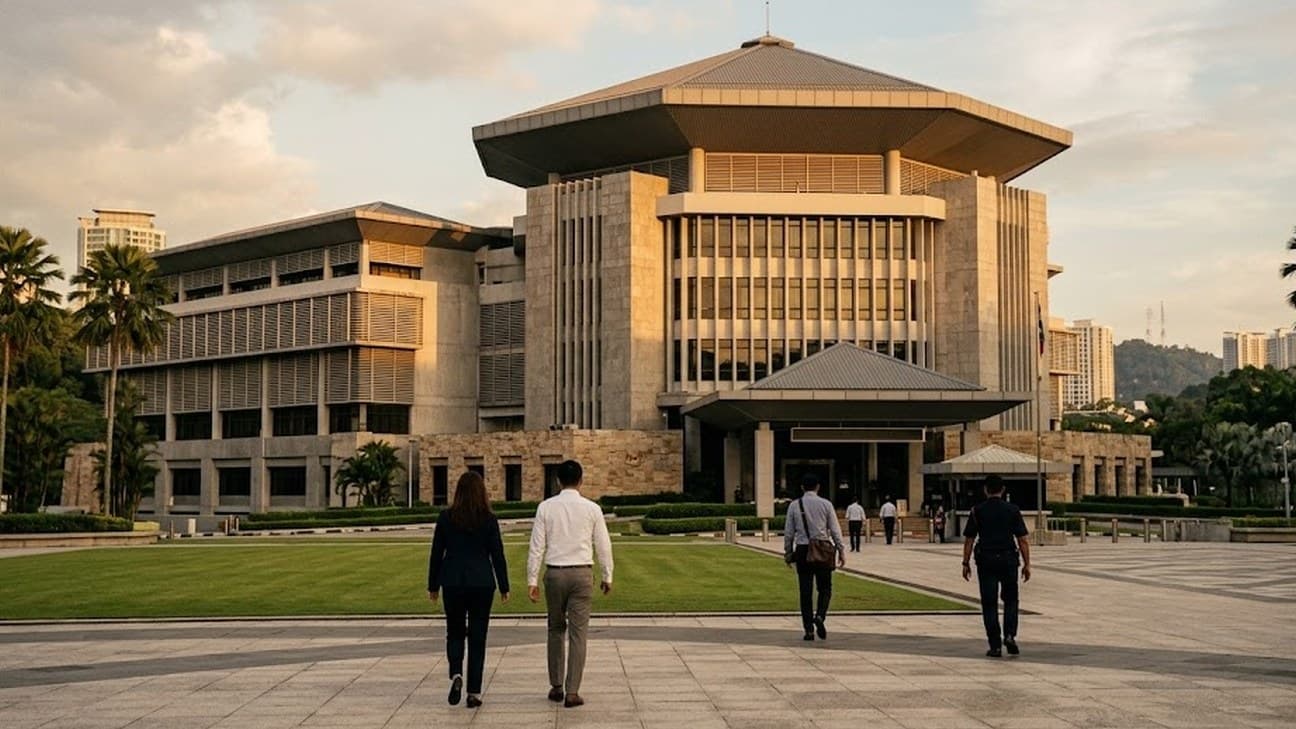
Photorealistic exterior photograph of a stately Thai government building in Bangkok with a colonnaded white facade and ornate gold-trimmed traditional Thai roof gables, a Thai national flag flying in the forecourt under hard midday sun, a uniformed security guard at the gatehouse and two office workers walking toward the entrance, small in frame relative to the building, with the modern city skyline visible behind.
Fitch's outlook upgrade turns on the same administrative stability Thai policymakers have been building toward all year.

Fitch Upgrades Thailand's Sovereign Outlook to Stable, Citing Debt Stabilization and Political Continuity

Fitch Ratings revised Thailand's sovereign outlook from Negative to Stable on September 18, affirming the country's long-term foreign-currency issuer default rating at BBB+, according to Bangkok-based Kaohoon International and The Nation Thailand. Fitch cited greater confidence that government debt will broadly stabilize over the medium term, alongside improved political visibility under the coalition government led by Prime Minister Anutin Charnvirakul, which the agency said has shown "greater administrative stability" than several recent predecessors. The revision brings all three major rating agencies — Fitch, Moody's, and S&P Global — into alignment on a Stable outlook for Thailand for the first time in several years.

Fitch forecasts Thai GDP growth of 2.3% in 2026, roughly in line with 2.4% in 2025, and expects public debt to stabilize below 63% of GDP by fiscal year 2028. The agency pointed to technology and data-centre investment as a source of underlying economic support, while flagging that public debt remains high relative to rating peers and that structural growth constraints will require continued fiscal reform.

Moody's: An AI-Driven Export Boom Is Cushioning ASEAN Growth Against Tariff and Energy Shocks

Moody's Analytics said Southeast Asia's economy is holding up better than headline risks suggest, with an AI-driven boom in data-centre investment and electronics exports offsetting the drag from elevated US tariffs, a Middle East-driven oil price spike, and softening domestic demand, according to TechNode Global. Moody's September baseline projects ASEAN growth easing only modestly to 4.8% in 2026 and 4.6% in 2027, down from 4.9% in 2025 — a smaller slowdown than earlier in the year's forecasts implied. Vietnam was flagged as the region's strongest performer, while economies less connected to the AI investment cycle, including the Philippines, are lagging.

The report cited compounding risks: Brent crude briefly topped $100 per barrel amid Middle East tensions, pushing Philippine headline inflation to 7.2% year-on-year in April; US effective tariff rates are expected to stay elevated through 2028, with risk tilted toward further escalation, though semiconductor carve-outs currently shield major regional exporters including Singapore, Malaysia, and Vietnam; and El Niño conditions threaten fertilizer-feedstock supply chains ahead of the harvest season.

Malaysian Treasurers Rank as Asia-Pacific's Most Bullish Digital-Currency Adopters, HSBC Finds

An HSBC survey of 680 treasury and finance professionals across 11 Asia-Pacific markets found Malaysian respondents the most enthusiastic in the region on digital-currency adoption: 50% said they were "very likely" to adopt digital currencies within the next two years, against a regional average of just 19%, according to The Star and Focus Malaysia. Respondents cited improved treasury efficiency (73%) and stronger liquidity management (50%) as the main expected benefits, drawn from HSBC's "Redefining Treasury in Asia Pacific 2026: Voices of Treasury" report.

On AI, 76% of Malaysian respondents believe the technology will be "extremely" or "very" useful to treasury functions within three years, ahead of the 72% regional average — but 82% conceded that treasury operations are not keeping pace with AI adoption elsewhere in their own organizations, citing systems integration (69%), cost (45%), and lack of in-house expertise (36%) as the main barriers. Malaysian respondents also rated cybercrime and fraud risk at 8.4 out of 10, above the 7.78 regional average.

Eyes on the Day Ahead

Thailand's SEC public consultation on draft rules for locally listed spot Bitcoin and Ether ETFs, and on qualification standards for foreign digital asset custodians, closes tomorrow, September 20 — the final day for industry comment before the regulator moves to revise and finalize the framework it hopes to bring into effect later this year.

Layer 7 Ventures is a research-driven firm focused on AI and cryptocurrency in Southeast Asia. Views expressed are those of the firm and do not constitute investment advice.


More Research

A shopkeeper in a plaid shirt and a helmeted delivery rider face each other across the counter of a Kuala Lumpur shophouse in harsh midday sun, with a card payment terminal and stacked cartons on the counter and motorbikes parked at the kerb.
Daily Brief · FinTech · Geopolitics4 min

SEA Daily Brief: Malaysia Lifts SME Financing to RM57 Billion and Tops Up BNM's Relief Facility, Thailand Plans an SME Credit Portal, and Vietnam Wins Its First Investment-Grade Rating

Malaysia's Budget 2027 raises SME loan facilities and financing guarantees to RM57 billion from RM50 billion, while Bank Negara Malaysia adds RM5 billion to its SME Stabilisation Relief Facility after RM3.8 billion of the first tranche was approved. The Bank of Thailand outlined an SME credit portal, an alternative data exchange and a five-year guarantee scheme aimed at about 100 billion baht of new SME lending a year, after a four-year decline. Japan's R&I upgraded Vietnam to BBB-, the first investment-grade rating from an international agency, while Moody's, S&P Global and Fitch still rate it sub-investment grade.

High-angle view of a Kuala Lumpur financial district at pre-dawn blue hour, with office towers, a river bend and a few tiny pedestrians crossing a floodlit plaza and a marked crosswalk.
Daily Brief · FinTech · AI4 min

SEA Daily Brief: Malaysia's Budget 2027 Backs Startups and Crowdfunding, the SC Reports 2025 Restitution Figures, and UOB Explores a Dedicated AWS Cloud for ASEAN

Malaysia's Budget 2027, tabled on 9 October, earmarks RM450 million for startups through Jelawang Capital and Dana Perintis and RM270 million to draw private capital into equity crowdfunding and P2P platforms, with no distribution mechanism disclosed. The Securities Commission told Parliament it returned RM1.98 million to 239 investors in 2025 and has set aside RM8.6 million for 933 more. UOB signed an MoU with AWS to explore a dedicated Singapore cloud environment for its five ASEAN markets, with no financial terms or timeline given.

Office workers and a security guard walk across a stone forecourt toward a modern government building with a sweeping roofline in Kuala Lumpur, lit by low golden-hour sun with palm trees and a lawn in the foreground.
Daily Brief · FinTech · Crypto · AI4 min

SEA Daily Brief: Malaysia's Budget 2027 Proposes Tokenised Retail Sukuk, Singapore Licenses Large Data Centres, and the NSRC Plans an AI Scam-Check App

Prime Minister Anwar Ibrahim proposed a blockchain-based retail savings sukuk in Budget 2027, tabled on 9 October, with no launch date, minimum investment or return disclosed. Singapore's Parliament passed the Digital Infrastructure Bill on 7 October, creating licensing regimes for data centres of 10MW or more and large cloud providers. Malaysia's National Scam Response Centre also plans an AI application to check suspicious numbers, accounts and links, with no funding or launch date stated.

Stay Informed

Get the next report in your inbox.