All reports
Daily Brief · FinTech · Crypto · AI

SEA Daily Brief: Malaysia's Budget 2027 Proposes Tokenised Retail Sukuk, Singapore Licenses Large Data Centres, and the NSRC Plans an AI Scam-Check App

Prime Minister Anwar Ibrahim proposed a blockchain-based retail savings sukuk in Budget 2027, tabled on 9 October, with no launch date, minimum investment or return disclosed. Singapore's Parliament passed the Digital Infrastructure Bill on 7 October, creating licensing regimes for data centres of 10MW or more and large cloud providers. Malaysia's National Scam Response Centre also plans an AI application to check suspicious numbers, accounts and links, with no funding or launch date stated.

October 9, 20264 min readMalaysia · Singapore · Budget 2027 · Tokenization · Sukuk · Data Centres · IMDA · AI · Scams · NSRC
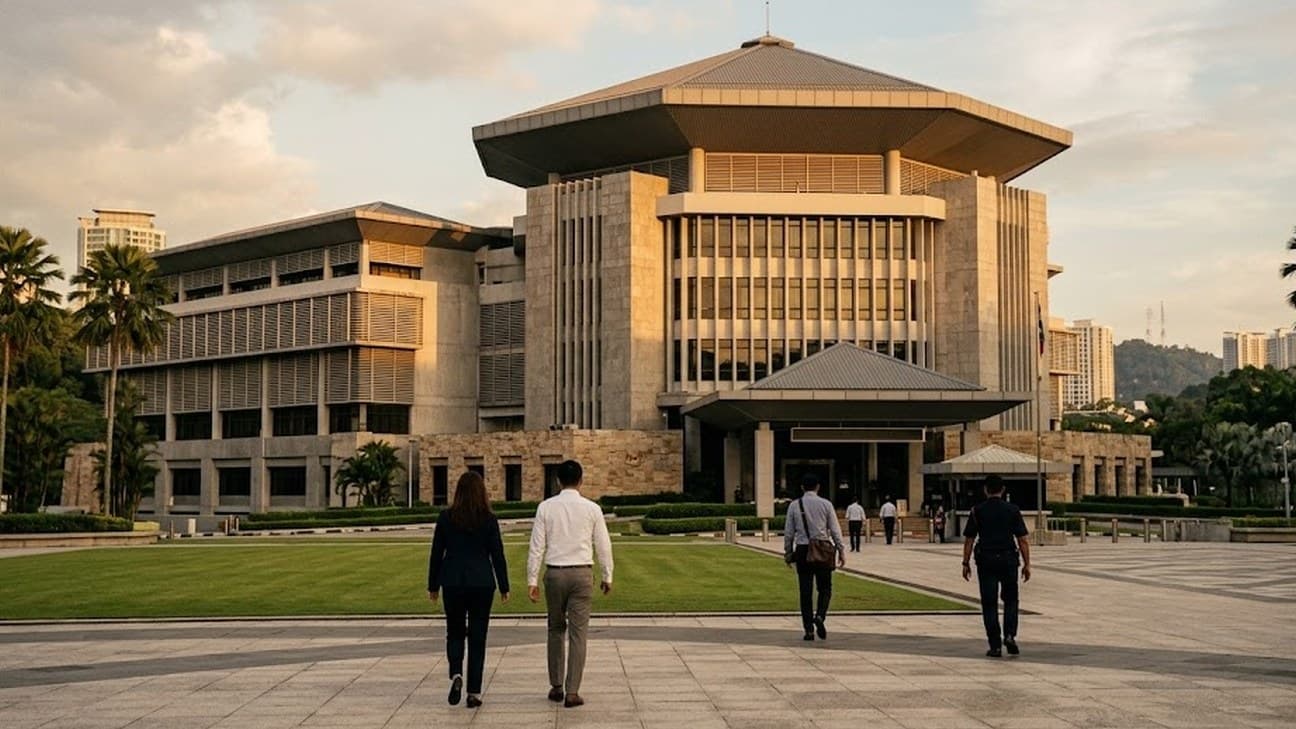
Office workers and a security guard walk across a stone forecourt toward a modern government building with a sweeping roofline in Kuala Lumpur, lit by low golden-hour sun with palm trees and a lawn in the foreground.
A government building forecourt in Kuala Lumpur, the setting for the Budget 2027 announcements on tokenised sukuk and AI scam checks.

Malaysia's Budget 2027 Proposes a Tokenised Retail Savings Sukuk

Prime Minister and Finance Minister Anwar Ibrahim announced a tokenised retail savings sukuk initiative while tabling Budget 2027 on 9 October 2026. Retail investors would buy government sukuk through a blockchain-based initiative, and could choose whether their funds support education, healthcare or social protection for low-income groups.

This is a proposal, not a launched product. The Budget speech did not specify a launch date, minimum investment amount or expected returns, and the report gives no detail on structure, issuers or platform operators. The institutional groundwork exists: Khazanah Nasional priced a RM100 million tokenised sukuk with the Securities Commission Malaysia in April 2026 (completed in May, with V Systems as technology provider), and CIMB completed a pilot in August using tokenised deposits to settle RM1.38 billion of tokenised sukuk.

Singapore Passes the Digital Infrastructure Bill, Licensing Large Data Centres and Cloud Providers

Singapore's Parliament passed the Digital Infrastructure Bill on 7 October 2026, creating two licensing regimes overseen by the Infocomm Media Development Authority (IMDA). The first covers co-location and cloud data centres with a critical IT load of at least 10 megawatts, and cloud providers whose IaaS and PaaS services generate at least S$100 million in average annual revenue from Singapore users over three years. Licensed operators must manage security risks, maintain recovery plans and report specified incidents to IMDA. Certain breaches may bring fines of up to S$1 million or 10 percent of annual Singapore turnover, whichever is higher.

The second regime requires data centres with a critical IT load of at least 3MW to obtain a licence and meet energy efficiency standards, for new and existing facilities; existing operators have six months from when the relevant provisions take effect to apply. The report does not state that date. The Ministry of Digital Development and Information attributes the push partly to an October 2023 cooling failure that disrupted banking and payment services for more than 12 hours, with over 810,000 failed access attempts and 2.5 million failed payment and ATM transactions. Singapore has more than 1.6 gigawatts of data centre capacity.

Malaysia's National Scam Response Centre Plans an AI App to Check Suspicious Numbers, Accounts and Links

Anwar Ibrahim announced in Budget 2027 that the National Scam Response Centre (NSRC) will develop an AI application that lets the public check suspicious phone numbers, bank accounts and links before making financial transactions. The report states the budget speech did not specify a funding allocation, launch date or technical details.

Anwar said the Malaysian Communications and Multimedia Commission has blocked more than 5.7 billion scam-related calls and SMS messages. In 2025, according to the MADANI portal, the NSRC handled 146,167 complaint calls and froze 138,915 accounts linked to fraud. Home Minister Saifuddin Nasution Ismail said the centre prevented RM34.05 million from reaching scam syndicates. The public can already check numbers, bank accounts and company names through the police's Semak Mule portal.

Eyes on the Day Ahead

No dated deadline falls in the next 24 to 48 hours in the sources reviewed, so this looks a few days out instead. The open items are the detail missing from Malaysia's Budget 2027 announcements (the sukuk's structure, launch date and supervisors, and the NSRC app's funding), and the commencement date for Singapore's Digital Infrastructure Bill. None has been scheduled.

Layer 7 Ventures is a research-driven firm focused on AI and cryptocurrency in Southeast Asia. Views expressed are those of the firm and do not constitute investment advice.

More Research

A shopkeeper in a plaid shirt and a helmeted delivery rider face each other across the counter of a Kuala Lumpur shophouse in harsh midday sun, with a card payment terminal and stacked cartons on the counter and motorbikes parked at the kerb.
Daily Brief · FinTech · Geopolitics4 min

SEA Daily Brief: Malaysia Lifts SME Financing to RM57 Billion and Tops Up BNM's Relief Facility, Thailand Plans an SME Credit Portal, and Vietnam Wins Its First Investment-Grade Rating

Malaysia's Budget 2027 raises SME loan facilities and financing guarantees to RM57 billion from RM50 billion, while Bank Negara Malaysia adds RM5 billion to its SME Stabilisation Relief Facility after RM3.8 billion of the first tranche was approved. The Bank of Thailand outlined an SME credit portal, an alternative data exchange and a five-year guarantee scheme aimed at about 100 billion baht of new SME lending a year, after a four-year decline. Japan's R&I upgraded Vietnam to BBB-, the first investment-grade rating from an international agency, while Moody's, S&P Global and Fitch still rate it sub-investment grade.

High-angle view of a Kuala Lumpur financial district at pre-dawn blue hour, with office towers, a river bend and a few tiny pedestrians crossing a floodlit plaza and a marked crosswalk.
Daily Brief · FinTech · AI4 min

SEA Daily Brief: Malaysia's Budget 2027 Backs Startups and Crowdfunding, the SC Reports 2025 Restitution Figures, and UOB Explores a Dedicated AWS Cloud for ASEAN

Malaysia's Budget 2027, tabled on 9 October, earmarks RM450 million for startups through Jelawang Capital and Dana Perintis and RM270 million to draw private capital into equity crowdfunding and P2P platforms, with no distribution mechanism disclosed. The Securities Commission told Parliament it returned RM1.98 million to 239 investors in 2025 and has set aside RM8.6 million for 933 more. UOB signed an MoU with AWS to explore a dedicated Singapore cloud environment for its five ASEAN markets, with no financial terms or timeline given.

Photorealistic editorial photograph of a government public-service hall in Malaysia, seated members of the public seen from behind facing a row of glass-fronted service counters where two masked clerks work at computers, under fluorescent ceiling lights.
Weekly Signal · FinTech · AI · Crypto · Geopolitics6 min

SEA Signal: Malaysia Suspends Zetrix AI and MyEG Over RM314 Million, GCash Prices the Philippines' Biggest IPO, and AMRO Prices the AI Downside

Malaysia's Road Transport Department suspended MyEG and Zetrix AI as government collection agents over RM314 million in unremitted revenue, a counterparty-risk test for a listed blockchain-and-AI group. GCash owner Mynt priced a roughly PHP 53 billion IPO as Philippine equity issuance has dried up, and AMRO modelled a 1.5 percentage-point hit to 2027 ASEAN+3 growth from an AI slowdown. SoftBank, Grab and PETROS also signed a framework to explore AI infrastructure in Sarawak, with no money attached yet.

Stay Informed

Get the next report in your inbox.