BIMB Securities: Power, Water, and Subsea Cables — Not Land — Are Now the Ceiling on Malaysia's Data-Centre Boom
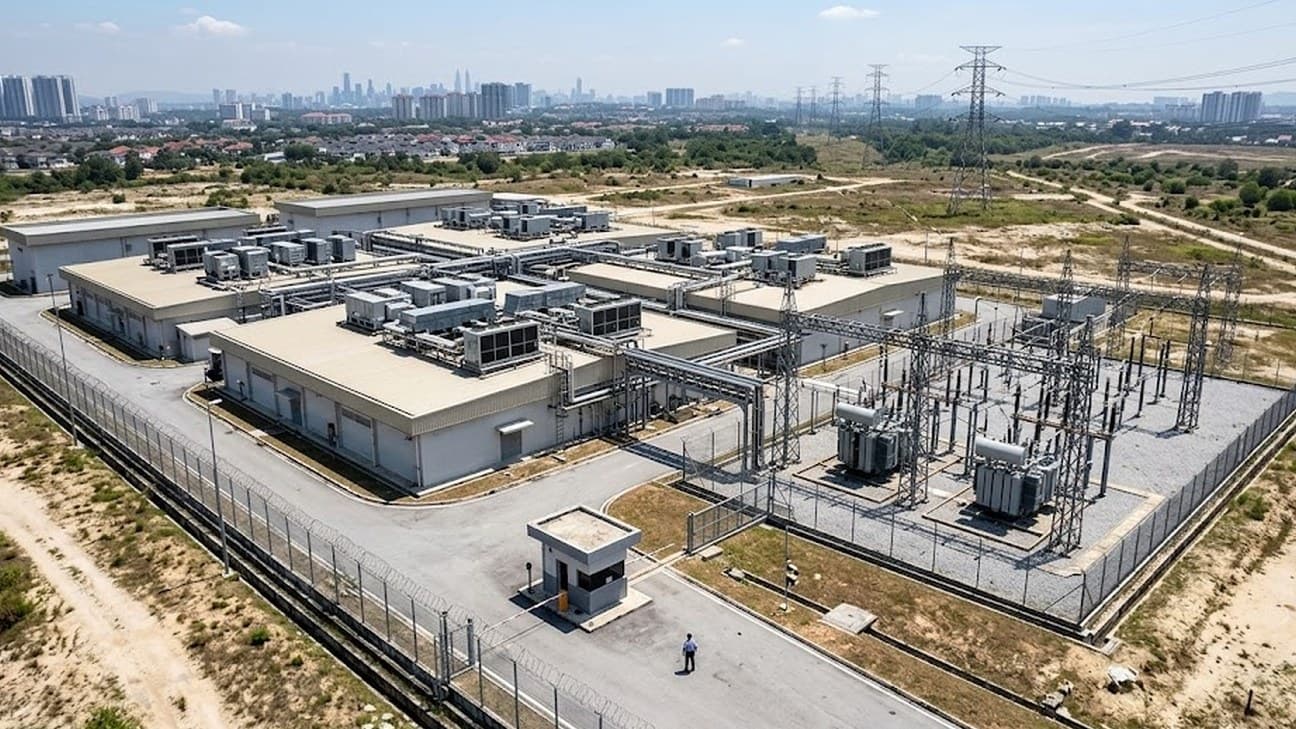
BIMB Securities said in a research note published September 4 that electricity has overtaken land as the primary constraint on Malaysia's data-centre expansion, as AI workloads push rack power density from a traditional 5–10kW up to 30–100kW or more. Tenaga Nasional Berhad (TNB) is currently supplying about 4.5GW of planned capacity to 36 operational data centres, with a further 23 projects under construction adding 3.8GW. National peak electricity demand is projected to climb from 21.3GW in 2026 to 33.5GW by 2035, with data centres alone rising from roughly 7% of Peninsular Malaysia's electricity consumption today to approximately 31% — about 73,274GWh a year — by 2035.
To keep pace, roughly MYR 43 billion ($10.63 billion) of grid-related capital expenditure has been approved under TNB's current regulatory period, and its Green Lane Pathway has cut grid-connection timelines for hyperscale customers from 36–48 months down to as little as 12, with 33 projects completed under the scheme as of March 2026. BIMB flagged water as the next binding constraint behind power, noting Johor-based operators including Bridge Data Centres, DayOne, and Computility have already moved to reclaimed-water supply agreements with Johor Special Water and Indah Water Konsortium. On connectivity, the note pointed to submarine cables — which carry over 95% of international internet traffic and are increasingly controlled by hyperscalers themselves — as a third, less visible constraint alongside existing systems (SEA-ME-WE, AAG, APG, AAE-1) and newer projects (MIST, ALC, Candle).
Thailand's SEC Proposes Retail Access to Overseas Crypto Derivatives, With Domestic-Equivalent Guardrails
Thailand's Securities and Exchange Commission opened a public consultation on September 1 proposing to let licensed intermediaries offer retail, high-net-worth, and ultra-high-net-worth investors access to select cryptocurrency derivatives traded on overseas exchanges. Eligible products would need to resemble domestic Thai crypto derivatives in underlying asset, maturity, leverage, delivery method, and settlement structure, and must trade on an exchange using central counterparty clearing that is overseen by a regulator belonging to IOSCO's Signatory A group or the World Federation of Exchanges. Non-qualifying products would remain restricted to institutional investors, whom the SEC considers better equipped to manage the associated risk.
The proposal arrives even as Thailand's own domestic derivatives market for crypto is still under construction: the Thailand Futures Exchange had not listed any cryptocurrency derivatives for public trading as of the consultation's opening date. The SEC has not specified an implementation timeline, an eligible-cryptocurrency list, approved overseas exchanges, or maximum leverage levels, leaving those details to be worked out after the consultation period closes on September 30.
Ripple and SettleMint Pair Custody and Tokenization Infrastructure for Regulated Asia-Pacific Institutions
Ripple and Belgium-based SettleMint announced a partnership on September 1, combining Ripple Custody's institutional digital-asset custody infrastructure with SettleMint's Digital Asset Lifecycle Platform (DALP) into a single stack covering issuance, compliance, custody, settlement, and servicing for tokenized assets. The offering is already available across Asia-Pacific — SettleMint maintains offices in Singapore, the UAE, and Japan alongside its Leuven headquarters — with expansion to other regions planned as institutional demand develops. Ripple Managing Director for Asia-Pacific Fiona Murray said the partnership "gives them the foundation to roll out digital assets," while SettleMint CEO Adam Popat framed it as a "single foundation" for institutions moving from pilot projects to live tokenization programs.
The companies cited a Boston Consulting Group projection that tokenized real-world assets could reach $88 trillion by 2035, alongside a warning that banks failing to adapt to digital-asset infrastructure could face a 30% profit reduction by that year. The deal follows a string of recent Ripple infrastructure moves, including partnerships with Securosys and Figment, integration of Chainalysis compliance tooling, and its acquisition of custody provider Palisade.
Eyes on the Day Ahead
Thailand's SEC consultation on retail access to overseas crypto derivatives stays open through September 30, and any indication of which overseas exchanges or products might qualify is worth tracking as the window progresses. In Malaysia, the InvestSmart x Bursa Marketplace Fair running September 5–6 in Kuala Lumpur is a near-term venue where SC and Bursa officials could field questions on the data-centre power constraints BIMB flagged this week.
Layer 7 Ventures is a research-driven firm focused on AI and cryptocurrency in Southeast Asia. Views expressed are those of the firm and do not constitute investment advice.