All reports
Daily Brief · AI · FinTech

SEA Daily Brief: Thailand-founded Amity makes Singapore its global AI hub ahead of a 2027 IPO, Penang and OSK Ventures open a financing channel for AI and deeptech startups, and Singapore's Qashier raises US$6.1 million for its regional merchant OS

Enterprise-AI firm Amity, founded in Thailand, opened a Singapore research and application centre as its regional headquarters and global AI research base, building on a US$100 million Series D disclosed in March and targeting US$200 million in annualised revenue ahead of a planned 2027 listing. Malaysia's state-backed Digital Penang and OSK Ventures signed a one-year memorandum to widen growth-stage financing for AI, hardtech and deeptech companies in Penang. And Singapore's Qashier raised a US$6.125 million Series A+ led by Cocoon Capital to expand a unified merchant operating system now running across four Southeast Asian markets.

June 30, 20264 min readThailand · Singapore · Malaysia · AI · Venture Capital · FinTech
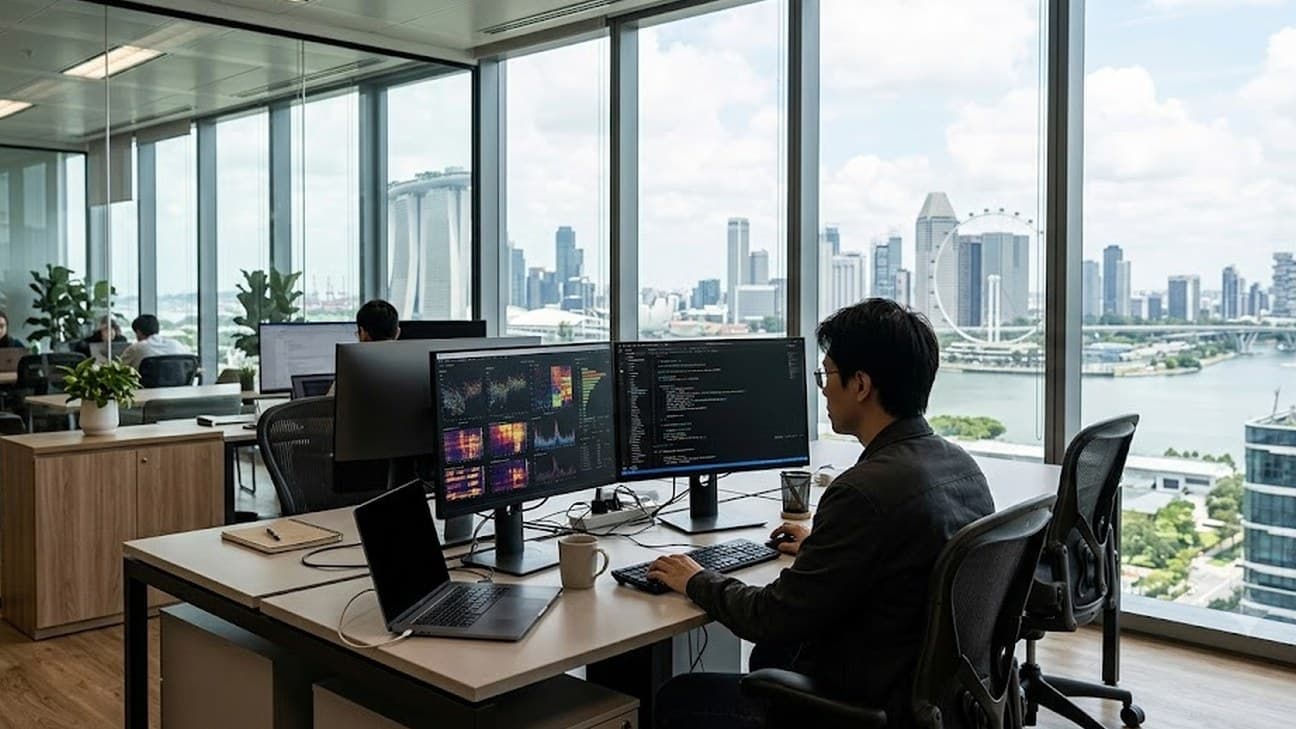
A researcher works at a multi-monitor workstation in a daylight AI research office in Singapore, a colleague visible in the background, the Singapore skyline through floor-to-ceiling windows
Amity's move to make Singapore its global AI research base underscores how enterprise-AI scale-ups are consolidating compute, research and capital in the city-state. (Illustrative image.)

Thailand-founded Amity opens a Singapore AI hub as its global research base, ahead of a planned 2027 IPO

Amity, an enterprise-AI software firm founded in Thailand, has launched a Singapore office and AI Research & Application Centre that will serve as its regional headquarters for Southeast Asia and the global home of its AI research capabilities, according to TechNode Global. The centre will develop industry-specific AI models for enterprise use and support clients across the region, with the company planning for up to 60 roles to be created there over the next three years.

The expansion builds on a US$100 million Series D round — disclosed in March and led by EDBI, the investment arm of SG Growth Capital, alongside Asia Partners, SMDV and CMLIM Capital — which DealStreetAsia reported at the time as the largest AI and machine-learning investment in Southeast Asia in the first quarter of 2026. Amity says it surpassed US$100 million in annualised revenue in 2025, is targeting US$200 million by end-2026, and is preparing for a public listing in 2027. Its deployment strategy leans on acquisitions in Europe and Southeast Asia.

Malaysia's Digital Penang and OSK Ventures open a one-year channel to finance AI and deeptech startups

Digital Penang, a Malaysian state-owned agency focused on the digital economy, and OSK Ventures International Berhad signed a one-year memorandum of understanding on June 29 to strengthen access to growth capital for startups and SMEs in Penang, with a focus on AI, hardtech and deeptech, according to TechNode Global. Digital Penang will act as a state-backed ecosystem enabler engaging with local companies, while OSK Ventures brings venture-financing expertise spanning both venture debt and equity.

The partnership explicitly targets a structural gap: limited access to growth-stage financing for companies in capital-intensive, technology-driven sectors, which typically face longer development cycles and more complex commercialisation paths than conventional businesses. The stated aim is to improve connectivity between high-potential enterprises and institutional capital providers, building a stronger pipeline of investment-ready companies.

Singapore's Qashier raises a US$6.125 million Series A+ to scale its four-market merchant operating system

Qashier, a Singapore-based unified merchant operating system for Southeast Asia, has raised US$6.125 million in a Series A+ round led by Cocoon Capital, with participation from IFP Securities, BlackSoil Global and strategic angel investors, according to TechNode Global. The platform bundles payments, business software, CRM and embedded financial services into more than 50 integrated modules, and currently operates across Singapore, Malaysia, Thailand and the Philippines, serving over 20,000 merchants processing roughly US$1 billion in annualised payment volume.

The company said it will use the capital for regional expansion and product development, including enhanced omnichannel payments, expanded embedded financial services, AI-enabled insights and workflow automation, and solutions for larger multi-outlet businesses. Its revenue-based lending product, QashierLoans, has disbursed more than US$10 million since launching in June 2025; Qashier has raised under US$20 million in total to date while reporting 61 percent annualised recurring-revenue growth.

Eyes on the Day Ahead

No fixed regulatory deadline falls in the next 24–48 hours, so the watch-list runs into early July. The nearer-term reads are commercial: whether Amity's Singapore-base and 2027-IPO messaging draws follow-on interest to Southeast Asia's thin roster of listing-bound enterprise-AI names, and whether the Digital Penang–OSK Ventures memorandum converts into disclosed venture-debt or equity commitments for Penang deeptech companies. Further out, watch Vietnam's pilot crypto-exchange framework — five domestically backed contenders have cleared an initial review — for movement toward live licensing as the country targets a Q3 2026 market launch, and Bank Negara Malaysia's timeline for greater clarity on ringgit stablecoins and tokenised deposits, which it has signalled for later in 2026.

Layer 7 Ventures is a research-driven firm focused on AI and cryptocurrency in Southeast Asia. Views expressed are those of the firm and do not constitute investment advice.
More Research

A wide editorial photograph of an institutional government building facade in Hanoi at pre-dawn blue hour, with a couple of anonymous office workers crossing the forecourt, small in frame relative to the building, no legible text or logos.
Daily Brief · Crypto · AI · FinTech4 min

SEA Daily Brief: Vietnam Fines Unlicensed Crypto Trading, S&P Says Malaysia's Data-Centre Boom Needs $20 Billion, and Singapore's Whale Raises $40 Million More

Vietnam signed Decree 284/2026/ND-CP, imposing its first-ever fines on domestic investors trading crypto assets outside licensed platforms, effective September 1 as five shortlisted exchanges prepare to launch. S&P Global Ratings said Malaysia can nearly triple its data-centre capacity by 2030 but needs roughly $20 billion in financing beyond what domestic banks can supply. And Singapore's Whale raised a $40 million Series C extension from Hong Kong, Japanese, Thai and Korean strategic investors to fund its push into the Middle East and Europe.

A wide editorial photograph of a high-density data centre server corridor with exposed liquid-cooling manifolds and copper pipes under cool blue LED status lights, a technician in a hi-vis vest seen from behind mid-stride down the aisle checking a tablet, no legible text or logos.
Daily Brief · AI · Crypto · FinTech4 min

SEA Daily Brief: IFC Backs a $175 Million Johor Data-Centre Expansion, Malaysia Reaffirms Binance Remains Unlicensed, and Singapore's SimpleAI Raises $15 Million to Buy Accounting Firms

The International Finance Corporation approved up to $175 million in combined debt and equity financing for AirTrunk's two hyperscale data centres in Johor Bahru, adding multilateral development capital to Malaysia's AI-infrastructure build-out. Malaysia's Ministry of Finance told Parliament that Binance remains unlicensed and blocked in the country, clarifying that its 2024 removal from the Securities Commission's Investor Alert List was never an authorization to operate. In Singapore, AI accounting-automation startup SimpleAI raised $15 million — a $5 million seed round plus a $10 million debt facility — to acquire small accounting and fund-administration firms across the region.

A wide aerial editorial photograph of a mixed-use waterfront development with distinctive high-rise towers and canals at overcast midday, small distant pedestrians crossing a plaza far below, no legible text or logos.
Daily Brief · Geopolitics · Crypto · Real Estate4 min

SEA Daily Brief: An Immigration Raid Freezes a $122 Million Malaysia Bet, SBI Closes Its Coinhako Buyout, and Wahed Opens Fractional Property Investing

An immigration check at Balaji Srinivasan's Network School campus in Johor's Forest City has frozen a $122 million expansion pending assurances from Prime Minister Anwar Ibrahim's office, even after authorities cleared every one of the 266 foreign residents checked. In Singapore, SBI Holdings closed its majority buyout of Coinhako a day after partnering with Ondo Finance to tokenize Japanese equities through its JPYSC stablecoin, using MAS-regulated infrastructure as a settlement layer it can't yet build at home. And in Malaysia, Wahed opened its Securities Commission sandbox-stage fractional real estate platform to the public, letting investors buy into individual properties from RM500.

Stay Informed

Get the next report in your inbox.