All reports
Daily Brief · FinTech · AI

Fitch Says Singapore's Data-Centre Capacity Crunch Is Spilling Into Johor, Singapore Fintech Funding Hits a Decade Low, and OSK Ventures Launches a Venture Debt Fund

Fitch Ratings says Singapore's data-centre capacity award of 200MW falls well short of demand, pushing overflow growth toward Johor, where operational capacity has already reached 1,110MW with vacancy at just 0.7%. Separately, KPMG's Pulse of Fintech report found Singapore fintech investment fell to US$499 million in H1 2026 — the weakest half in nearly a decade — even as AI and machine learning led deal activity by count. And OSK Ventures International and Affin Hwang Investment Bank launched Pothos Fund I, a venture debt vehicle aimed at mature Southeast Asian startups seeking less-dilutive financing.

August 29, 20264 min readSingapore · Malaysia · AI Infrastructure · Venture Capital · Data Centres
Photorealistic aerial photograph of a hyperscale data centre campus under construction in Johor, Malaysia, with cranes, cooling units, and a security perimeter fence, a construction worker in hi-vis visible in the foreground at golden hour.
A data-centre campus under construction in Johor, where Fitch says overflow demand from Singapore's capacity-constrained market is increasingly landing.

Fitch Says Singapore's Data-Centre Capacity Crunch Is Spilling Into Johor

Fitch Ratings said Singapore's provisional award of 200 megawatts of new data-centre capacity "falls well short of capacity sought by competing proposals," with unmet demand expected to redirect toward Johor, Malaysia. Singapore's data-centre occupancy rate stood above 95% in the first half of 2026. Johor, meanwhile, already had 1,110MW of operational IT capacity as of the first half, with a further 602MW under construction and 2,486MW planned — against a colocation vacancy rate of just 0.7%.

Fitch framed the dynamic as one where "infrastructure rather than demand" is now setting the pace of growth across the Singapore-Johor corridor, with power availability, land, and permitting increasingly the binding constraints rather than customer appetite. The agency added that this environment will "favor operators with secured utility access, established relationships and proven capabilities," while noting that "demand fundamentals remain favorable" as cloud adoption, enterprise digitalization, and AI workloads continue to drive expansion.

Singapore Fintech Investment Hits Its Weakest Half in Nearly a Decade, KPMG Finds

Singapore's fintech sector drew US$499 million in investment across 53 deals in the first half of 2026, according to KPMG's Pulse of Fintech H1'2026 report — down sharply from US$1.45 billion across 97 deals in H1 2025, and the most subdued half the country has recorded in close to ten years. Q1 came in at US$88 million across 26 deals, before a US$320 million cross-border payments round lifted Q2 to US$411 million across 27 deals; that single round accounted for nearly two-thirds of the half's total disclosed value.

AI and machine learning led deal activity by count, appearing in 18 of the 53 transactions and accounting for US$365.9 million in disclosed value, split roughly evenly between early- and late-stage rounds. Antony Ruddenklau, KPMG's global head of fintech and innovation and head of payments for Asia Pacific, said the pattern reflects a broader shift in which "investors are being far more selective, consolidating capital behind a small number of scaled, high-conviction platforms" rather than the broader-based funding activity of prior years.

OSK Ventures and Affin Hwang Launch Pothos Fund I, a Venture Debt Fund for Mature Malaysian Startups

OSK Ventures International Berhad and Affin Hwang Investment Bank Berhad launched Pothos Fund I, their first joint venture debt fund, offering a three-year debt-equity hybrid financing structure aimed at revenue-generating Southeast Asian companies with proven business models and predictable cash flows. The fund is pitched at mature, venture-backed companies looking to extend runway and fund regional expansion without further diluting existing shareholders.

OSK Ventures chief executive Amelia Ong said the fund is meant to help "build a more complete funding ecosystem" for companies that have outgrown pure equity rounds but aren't yet ready for conventional bank debt. Affin Hwang Investment Bank chief executive Hanif Ghulam said the partnership combines "complementary strengths and deep market expertise" between OSK Ventures' two decades of tech and enterprise investing and Affin Hwang's capital markets and investor-network access.

Eyes on the Days Ahead

No specific regulatory deadline or scheduled decision falls in the next 24-48 hours, so pivoting slightly further out: Thailand's SEC is accepting public comment on its draft spot Bitcoin and Ether ETF rules through September 20, 2026, the consultation window investors should track for the region's next concrete digital-asset milestone.

Layer 7 Ventures is a research-driven firm focused on AI and cryptocurrency in Southeast Asia. Views expressed are those of the firm and do not constitute investment advice.


More Research

A shopkeeper in a plaid shirt and a helmeted delivery rider face each other across the counter of a Kuala Lumpur shophouse in harsh midday sun, with a card payment terminal and stacked cartons on the counter and motorbikes parked at the kerb.
Daily Brief · FinTech · Geopolitics4 min

SEA Daily Brief: Malaysia Lifts SME Financing to RM57 Billion and Tops Up BNM's Relief Facility, Thailand Plans an SME Credit Portal, and Vietnam Wins Its First Investment-Grade Rating

Malaysia's Budget 2027 raises SME loan facilities and financing guarantees to RM57 billion from RM50 billion, while Bank Negara Malaysia adds RM5 billion to its SME Stabilisation Relief Facility after RM3.8 billion of the first tranche was approved. The Bank of Thailand outlined an SME credit portal, an alternative data exchange and a five-year guarantee scheme aimed at about 100 billion baht of new SME lending a year, after a four-year decline. Japan's R&I upgraded Vietnam to BBB-, the first investment-grade rating from an international agency, while Moody's, S&P Global and Fitch still rate it sub-investment grade.

High-angle view of a Kuala Lumpur financial district at pre-dawn blue hour, with office towers, a river bend and a few tiny pedestrians crossing a floodlit plaza and a marked crosswalk.
Daily Brief · FinTech · AI4 min

SEA Daily Brief: Malaysia's Budget 2027 Backs Startups and Crowdfunding, the SC Reports 2025 Restitution Figures, and UOB Explores a Dedicated AWS Cloud for ASEAN

Malaysia's Budget 2027, tabled on 9 October, earmarks RM450 million for startups through Jelawang Capital and Dana Perintis and RM270 million to draw private capital into equity crowdfunding and P2P platforms, with no distribution mechanism disclosed. The Securities Commission told Parliament it returned RM1.98 million to 239 investors in 2025 and has set aside RM8.6 million for 933 more. UOB signed an MoU with AWS to explore a dedicated Singapore cloud environment for its five ASEAN markets, with no financial terms or timeline given.

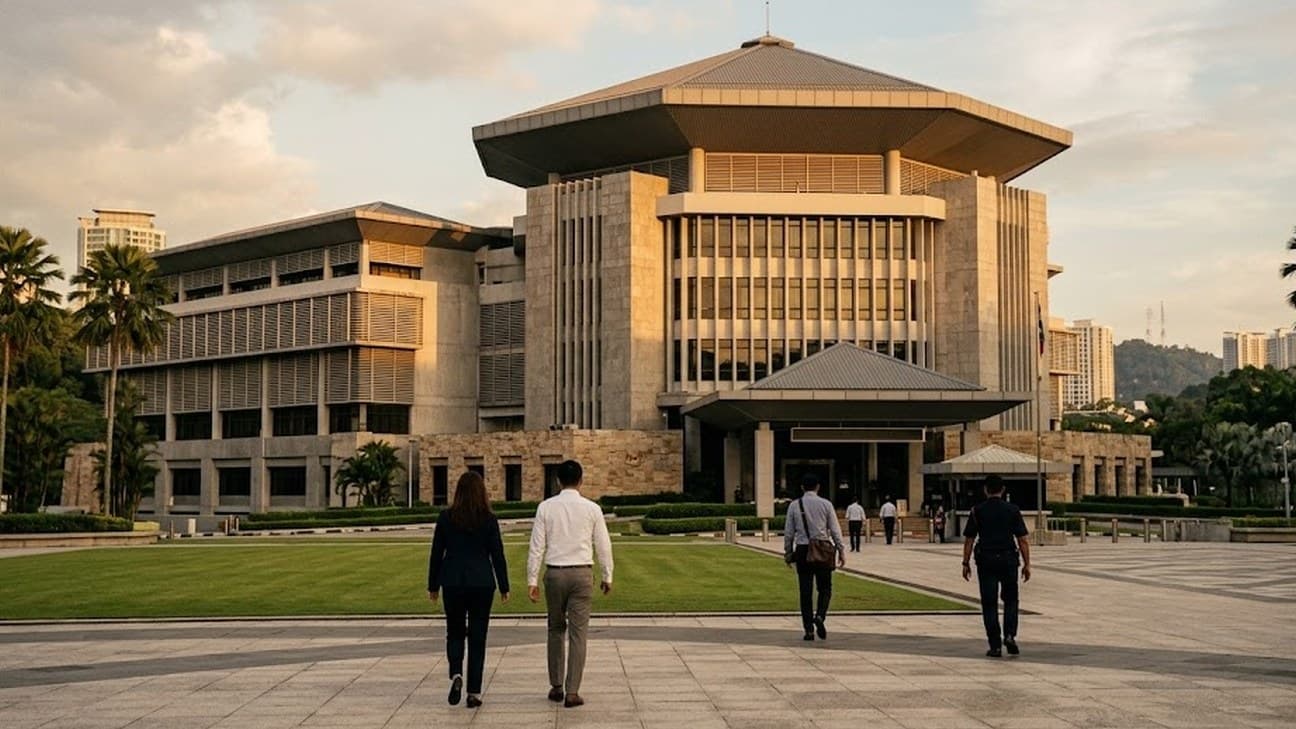
Office workers and a security guard walk across a stone forecourt toward a modern government building with a sweeping roofline in Kuala Lumpur, lit by low golden-hour sun with palm trees and a lawn in the foreground.
Daily Brief · FinTech · Crypto · AI4 min

SEA Daily Brief: Malaysia's Budget 2027 Proposes Tokenised Retail Sukuk, Singapore Licenses Large Data Centres, and the NSRC Plans an AI Scam-Check App

Prime Minister Anwar Ibrahim proposed a blockchain-based retail savings sukuk in Budget 2027, tabled on 9 October, with no launch date, minimum investment or return disclosed. Singapore's Parliament passed the Digital Infrastructure Bill on 7 October, creating licensing regimes for data centres of 10MW or more and large cloud providers. Malaysia's National Scam Response Centre also plans an AI application to check suspicious numbers, accounts and links, with no funding or launch date stated.

Stay Informed

Get the next report in your inbox.