All reports
Daily Brief · FinTech · AI

GXBank and Touch 'n Go Embed a RM150,000 Credit Line Inside Malaysia's Biggest eWallet, Vietnam's Sacombank Rebuilds Its Core Banking on Temenos and IBM, and Stripe Marks 10 Years in Singapore With a Six-Wallet Checkout Expansion

GXBank and TNG Digital launched FlexiCredit, a revolving credit line worth up to RM150,000 embedded directly inside the Touch 'n Go eWallet app, extending Malaysia's push toward embedded finance without requiring users to open a separate bank account. Vietnam's Sacombank completed a core banking overhaul on the latest Temenos platform running on IBM Power and Red Hat OpenShift, migrating from on-premises infrastructure to hybrid cloud with a claimed 200% performance gain. And Stripe marked ten years operating in Singapore by adding six Southeast Asian payment methods to its checkout and launching an Adaptive Pricing tool it says lifts cross-border revenue by 17.8% on average.

August 26, 20264 min readMalaysia · Vietnam · Singapore · Embedded Finance · Payments · Banking Infrastructure
Photorealistic photograph of an anonymous person in silhouette holding a smartphone, seen from behind and over the shoulder with the phone screen unreadable, standing in a busy Kuala Lumpur street at dusk with illuminated shopfronts blurred in the background.
A smartphone payment on a Malaysian street at dusk — the setting for GXBank and Touch 'n Go's new embedded credit line this week.

GXBank and Touch 'n Go Embed a RM150,000 Revolving Credit Line Directly Inside Malaysia's Biggest eWallet

GXBank and TNG Digital launched FlexiCredit, a revolving credit line of up to RM150,000 embedded directly inside the Touch 'n Go eWallet app — Malaysia's most widely used e-wallet. Users can draw funds as needed at rates starting from 3.78% flat per annum (6.45% effective annual rate), over repayment terms of 6 to 60 months, with approval available within minutes and minimal documentation. Critically, the product requires no separate bank account: it sits inside the wallet app users already have open.

The launch extends TNG's GOfinance ecosystem, which already bundles investment, insurance, credit and remittance services inside the wallet. GXBank chief executive Kaushik Chowdhury said FlexiCredit was "designed for everyday Malaysians," emphasising the absence of lengthy paperwork.

Vietnam's Sacombank Rebuilds Its Core Banking Platform on Temenos and IBM Hybrid Cloud

Sacombank, one of Vietnam's largest private banks, completed a migration to the latest Temenos Core Banking platform, moving from on-premises infrastructure to a hybrid cloud environment built on Red Hat OpenShift and IBM Power. The bank also adopted Temenos Payments Hub to handle cross-border payment flows. The system underpins retail and SME banking for millions of customers and processes 13 million transactions daily.

Temenos cites a 200% performance improvement in application throughput, deployment cycles three times faster than before, and a 50% smaller server footprint from the migration. Sacombank deputy chief executive Luu Danh Duc said the upgrade gives the bank "a scalable, high-performing and flexible foundation" to "accelerate innovation, deliver new services faster."

Stripe Marks 10 Years in Singapore With a Six-Wallet Checkout Expansion and an Adaptive Pricing Tool

Stripe marked its tenth year operating in Singapore — where it now serves more than 80,000 businesses and sole proprietors, over 60% of whom sell internationally — by adding six Southeast Asian payment methods to its Singapore checkout: Samsung Pay, MoMo, GCash, Touch 'n Go, PromptPay and TrueMoney. ShopeePay and SPayLater are slated to follow across the region in the fourth quarter of 2026.

Alongside the payment-method expansion, Stripe launched a Managed Payments service letting digital businesses sell into 195 countries without establishing local entities — Stripe absorbs indirect tax handling, dispute management, fraud protection and customer support, routing transactions through its own local entities to improve payment success rates. It also introduced an Adaptive Pricing tool that automatically displays prices in a customer's local currency, which Stripe says produces an average 17.8% uplift in cross-border revenue. A full Treasury service, letting businesses hold and spend balances and pay suppliers across nearly 100 countries by email address, is planned for early 2027.

Eyes on the Day Ahead

Techsauce Global Summit 2026 continues in Bangkok through August 28; worth watching for further AI-infrastructure and digital-asset announcements from regional regulators and vendors attending.

Layer 7 Ventures is a research-driven firm focused on AI and cryptocurrency in Southeast Asia. Views expressed are those of the firm and do not constitute investment advice.


More Research

A shopkeeper in a plaid shirt and a helmeted delivery rider face each other across the counter of a Kuala Lumpur shophouse in harsh midday sun, with a card payment terminal and stacked cartons on the counter and motorbikes parked at the kerb.
Daily Brief · FinTech · Geopolitics4 min

SEA Daily Brief: Malaysia Lifts SME Financing to RM57 Billion and Tops Up BNM's Relief Facility, Thailand Plans an SME Credit Portal, and Vietnam Wins Its First Investment-Grade Rating

Malaysia's Budget 2027 raises SME loan facilities and financing guarantees to RM57 billion from RM50 billion, while Bank Negara Malaysia adds RM5 billion to its SME Stabilisation Relief Facility after RM3.8 billion of the first tranche was approved. The Bank of Thailand outlined an SME credit portal, an alternative data exchange and a five-year guarantee scheme aimed at about 100 billion baht of new SME lending a year, after a four-year decline. Japan's R&I upgraded Vietnam to BBB-, the first investment-grade rating from an international agency, while Moody's, S&P Global and Fitch still rate it sub-investment grade.

High-angle view of a Kuala Lumpur financial district at pre-dawn blue hour, with office towers, a river bend and a few tiny pedestrians crossing a floodlit plaza and a marked crosswalk.
Daily Brief · FinTech · AI4 min

SEA Daily Brief: Malaysia's Budget 2027 Backs Startups and Crowdfunding, the SC Reports 2025 Restitution Figures, and UOB Explores a Dedicated AWS Cloud for ASEAN

Malaysia's Budget 2027, tabled on 9 October, earmarks RM450 million for startups through Jelawang Capital and Dana Perintis and RM270 million to draw private capital into equity crowdfunding and P2P platforms, with no distribution mechanism disclosed. The Securities Commission told Parliament it returned RM1.98 million to 239 investors in 2025 and has set aside RM8.6 million for 933 more. UOB signed an MoU with AWS to explore a dedicated Singapore cloud environment for its five ASEAN markets, with no financial terms or timeline given.

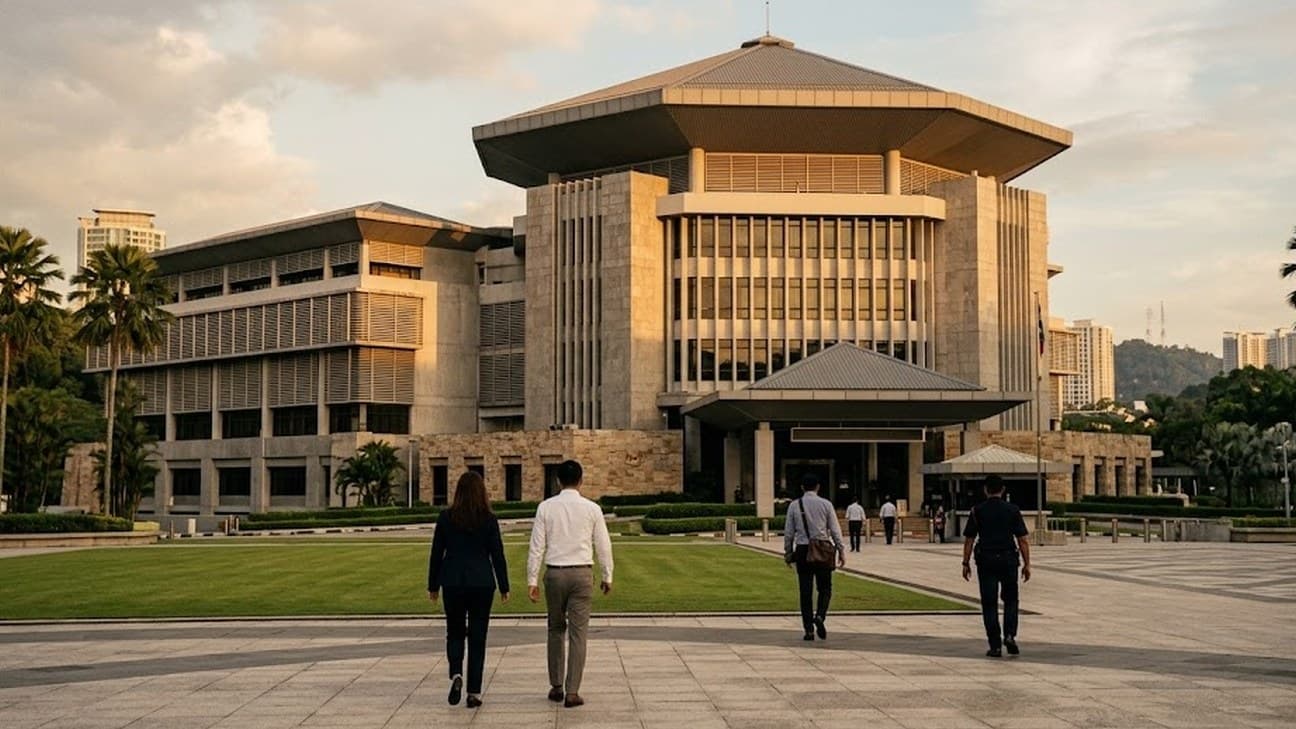
Office workers and a security guard walk across a stone forecourt toward a modern government building with a sweeping roofline in Kuala Lumpur, lit by low golden-hour sun with palm trees and a lawn in the foreground.
Daily Brief · FinTech · Crypto · AI4 min

SEA Daily Brief: Malaysia's Budget 2027 Proposes Tokenised Retail Sukuk, Singapore Licenses Large Data Centres, and the NSRC Plans an AI Scam-Check App

Prime Minister Anwar Ibrahim proposed a blockchain-based retail savings sukuk in Budget 2027, tabled on 9 October, with no launch date, minimum investment or return disclosed. Singapore's Parliament passed the Digital Infrastructure Bill on 7 October, creating licensing regimes for data centres of 10MW or more and large cloud providers. Malaysia's National Scam Response Centre also plans an AI application to check suspicious numbers, accounts and links, with no funding or launch date stated.

Stay Informed

Get the next report in your inbox.