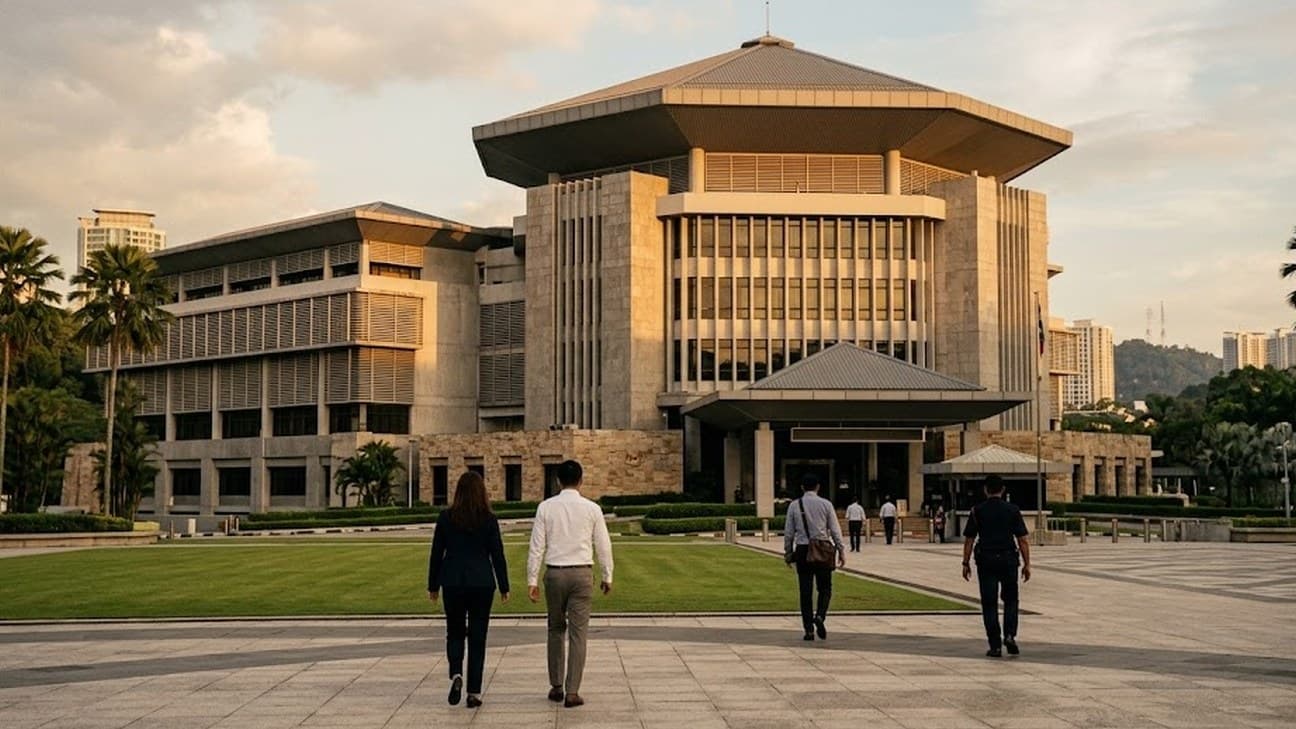
HSBC Survey Finds 85% of Malaysia's Affluent Investors Already Use AI for Finance — Third-Highest in the World
A new HSBC survey of affluent and high-net-worth investors finds 85% of respondents in Malaysia already use AI tools for finance and investment decisions, placing the country third globally behind India (86%) and tied with mainland China, and well above the 73% average across all surveyed markets. Adoption skews generational: 89% among Millennials (30-45) versus 78% among Baby Boomers (62-69). More broadly, 64% of Malaysian respondents said they use AI tools for work and career development, not just investing.
Despite the high usage numbers, humans still dominate where it counts: 58% of respondents said they prefer combining AI with professional human expertise rather than relying on AI alone, and financial professionals remain the leading source of actual investment ideas at 65%, more than four times as influential as AI tools at 16%. "Technology provides speed while human connection builds trust," said Linda Yip, HSBC Malaysia's Country Head of International Wealth and Premier Banking. "The future of banking can feature a partnership between AI-driven insights and human expertise."
Singapore's Acrab Raises $130 Million Series B to Push Its Edge AI Chip Platform Toward Commercial Deployment
Acrab, a Singapore-based AI infrastructure startup founded in 2024, closed a $130 million Series B led by existing investors Vertex Ventures Southeast Asia & India and Vertex Growth, with additional unnamed new investors participating. The round takes the company's cumulative funding past $480 million. Acrab builds a full-stack AI computing platform pairing custom silicon with edge AI models and software orchestration: its GΞLIX 1 chip is designed to run large language models at roughly the 100-billion-parameter scale locally, and its "Agent Box" product packages that chip into a personal edge AI system supporting on-device inference, persistent memory and multimodal interaction without routing through the cloud.
Management said it expects to generate revenue within the year through industrial deployments across multiple sectors, and will deploy the new capital toward scaling production and developing next-generation platforms. The raise lands inside a broader Asia-wide AI funding boom — startups across the region raised at least $20.3 billion in disclosed capital in the first half of 2026 — but with roughly 90% of that total concentrated in Greater China, making Acrab's round one of the larger Southeast Asia-specific tickets in that pool.
ADB Finds Philippine Fintechs Face a 48% Technical Skills Gap, With AI and Cybersecurity the Weakest Spots
A joint report from the Asian Development Bank and the Global Fintech Institute, "Bridging the Divide: An ASEAN Fintech Skills Framework," finds an overall technical skills gap of 48% and a soft skills gap of 46% across the Southeast Asian fintech sector. In the Philippines specifically, 88% of surveyed businesses said workforce shortages are significantly hurting their ability to meet business objectives, and the country received only a "developing" proficiency rating in AI-enabled services, cybersecurity, digital lending and RegTech — despite established advantages in IT-BPM services and English-proficient talent. The report frames this against fast-moving adoption on the consumer side: digital payments reached 52.8% of retail transactions in 2023, up from 42.1% the year before.
The report's recommended fixes center on public-private training partnerships, which 61% of surveyed businesses identified as the most effective intervention, alongside leaning on government initiatives like the Philippines' AI Academy and building cross-border mobility pathways with industry-recognized digital-skills credentials. Its authors stress that "technical expertise alone is insufficient" — closing the gap requires pairing technical training with soft skills and industry-specific knowledge, not just more coding bootcamps.
Eyes on the Day Ahead
Indonesia Blockchain Week 2026 opens August 12-13 at the Jakarta International Convention Center, bringing together regional builders, investors and regulators — a direct venue to watch for any fresh signal on Indonesia's digital-asset licensing regime or AI-tokenization commentary from OJK-adjacent speakers over the next two days.
Layer 7 Ventures is a research-driven firm focused on AI and cryptocurrency in Southeast Asia. Views expressed are those of the firm and do not constitute investment advice.