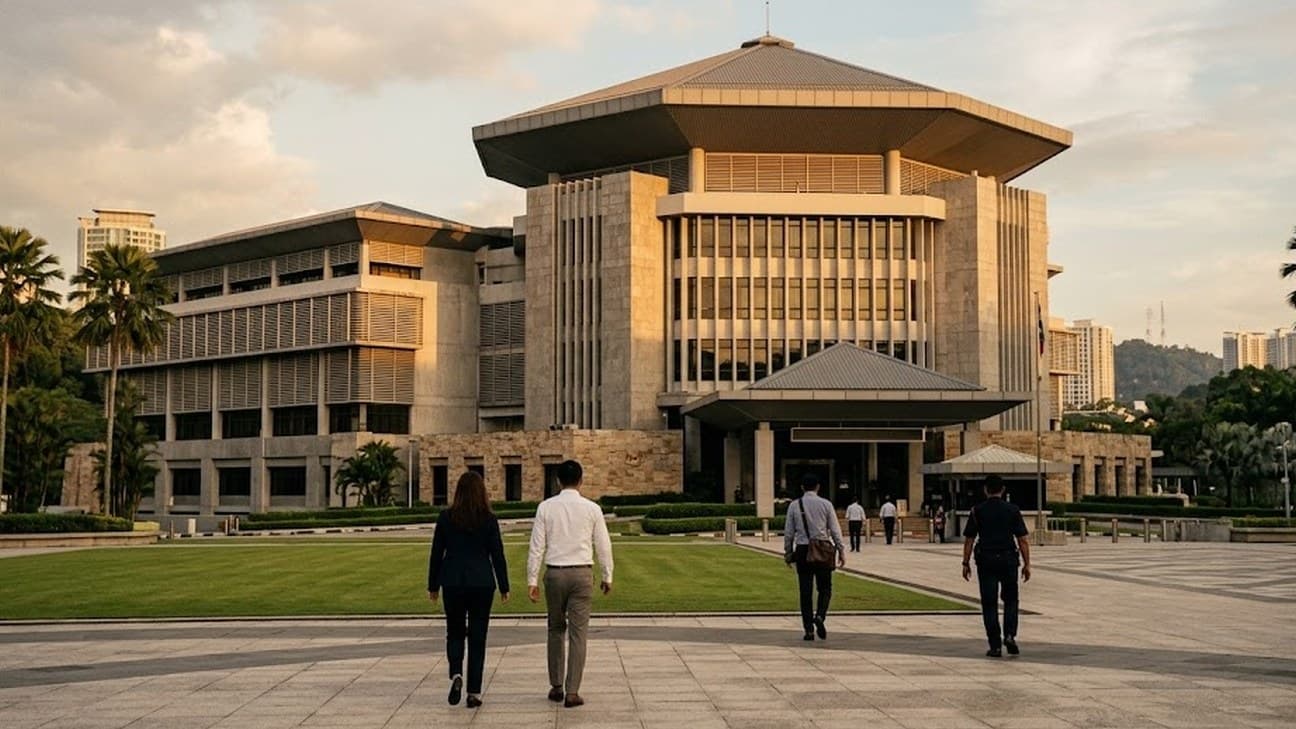
Malaysian Banks Are Rewiring Cyber Defence Around AI Agents as Non-Human Identities Outnumber Humans 144 to 1
Malaysian bank security chiefs say the security perimeter has moved past the firewall as real-time payments leave less time to catch fraud. Scam losses in Malaysia reached RM2.8 billion in 2025, and non-human digital identities — service accounts, bots and AI agents — now outnumber human ones inside bank systems by roughly 144 to 1, up from about 80 to 1 a year earlier. "We are moving from protecting or monitoring the wall towards monitoring the behaviour of the user or client," said Tahrizi Tahreb, chief information security officer at Bank Kerjasama Rakyat Malaysia (Bank Rakyat), adding that "identity is no longer one element of security. It is the security."
Goh Ser Yoong, CISO at Ryt Bank (YTL Digital Bank), said identity verification now has to start at onboarding rather than login, with document and consent checks built in from the first interaction rather than layered on afterward. Shankar Krishnan, chief technology officer at Boost Bank, framed the shift in blunter terms: "the perimeter now extends into our parents' pockets." Banks are also preparing for a future in which their own AI agents exchange data directly with partner organisations' agents — a scenario that complicates authentication in ways traditional network security wasn't built for. Bank Negara Malaysia and the National Scam Response Centre's 997 hotline were cited as the regulatory and reporting backstop for the current wave of real-time-payment fraud.
Singapore's 1exchange Becomes a Validator on Canton, Betting Institutional Tokenization Needs Privacy Rails
1exchange, a Recognized Market Operator regulated by the Monetary Authority of Singapore, said on August 4 it had been approved as a validator on Canton, a privacy-enabled public blockchain built for institutional capital markets that the network says processes more than 600,000 transactions daily. Singapore payments institution FOMO Pay, which operates across Singapore, Hong Kong and the Middle East, joined alongside it, running a dedicated node to explore business-to-business payment and settlement use cases. Canton's selective-disclosure design lets participants share transaction data only with authorised counterparties while still transacting on a shared network, and supports compliance controls such as transfer restrictions and investor-eligibility checks.
1exchange chief executive Sheena Lim said "the future of tokenization will be defined not only by the assets brought on-chain, but also by the quality of the market infrastructure" supporting them, while Canton co-founder and Digital Asset chief executive Yuval Rooz said the addition helps the network "expand our presence in Asia" to meet regional demand. 1exchange intends to use the validator role to support its existing tokenization, listing and secondary-trading business for real-world assets, protecting investor identities and ownership records that would otherwise be exposed on a fully public chain.
GCash's Parent Posts Record Quarterly Revenue but a Shrinking Profit Contribution Ahead of Its October IPO
Mynt, the parent of Philippine e-wallet GCash, posted record second-quarter revenue of P22.4 billion, but Globe Telecom's equity share of Mynt's net income came to P3.7 billion, down from P3.8 billion a year earlier — a decline of 12% year-on-year and 8% quarter-on-quarter that one analyst note called "the key disappointment" in an otherwise strong Globe earnings report. The drag traces to the delinking of mobile casino apps from e-wallets in late 2025. Following board approval on June 17, Mynt submitted its registration statement to the Securities and Exchange Commission and its listing application to the Philippine Stock Exchange for a planned initial public offering targeted for the fourth quarter, which could raise as much as $1.5 billion. Globe holds roughly 33.8% of Mynt, alongside Ayala Corp. and Ant Group.
The split shows up in Globe's own numbers too: first-half 2026 net income fell 11% year-on-year to P11.0 billion despite record first-half service revenue, with Globe's core telecom segments — wireless and wireline — outperforming while Mynt underperformed against expectations. Globe's management has continued to describe the IPO as an open option with the registration process now formally underway rather than a certainty on any fixed date.
Eyes on the Day Ahead
Malaysia's Ministry of Digital and MyDIGITAL Corporation co-host AI Malaysia Takeover 2026 (AIMTO_26) in Kuala Lumpur on August 11-12, a direct venue to watch for any government signal on AI governance standards for the financial sector following today's reporting on bank-level AI-agent security practices.
Layer 7 Ventures is a research-driven firm focused on AI and cryptocurrency in Southeast Asia. Views expressed are those of the firm and do not constitute investment advice.