All reports
Daily Brief · AI · FinTech

SoftBank's Telecom Arm Joins a Four-Country ASEAN AI Data-Centre Alliance, Grab's Lending Book Doubles, and Every Malaysian IT Buyer Says They Will Spend More on AI

A SoftBank subsidiary, Singapore's SC ZEUS and Malaysia's Robust HPC have agreed to build AI data centres across Malaysia, Thailand, Indonesia and Vietnam on liquid-cooled, 800 VDC infrastructure — and to sell GPU capacity as a service rather than lease shells. Grab's financial services arm grew revenue 59% year-on-year as its loan book expanded to US$2.3 billion. And an Alibaba Cloud survey found Malaysia was the only Asian market where every single IT decision-maker surveyed intends to raise AI spending.

August 4, 20264 min readMalaysia · Singapore · Indonesia · Vietnam · Thailand · AI · Data Centres · Digital Banking
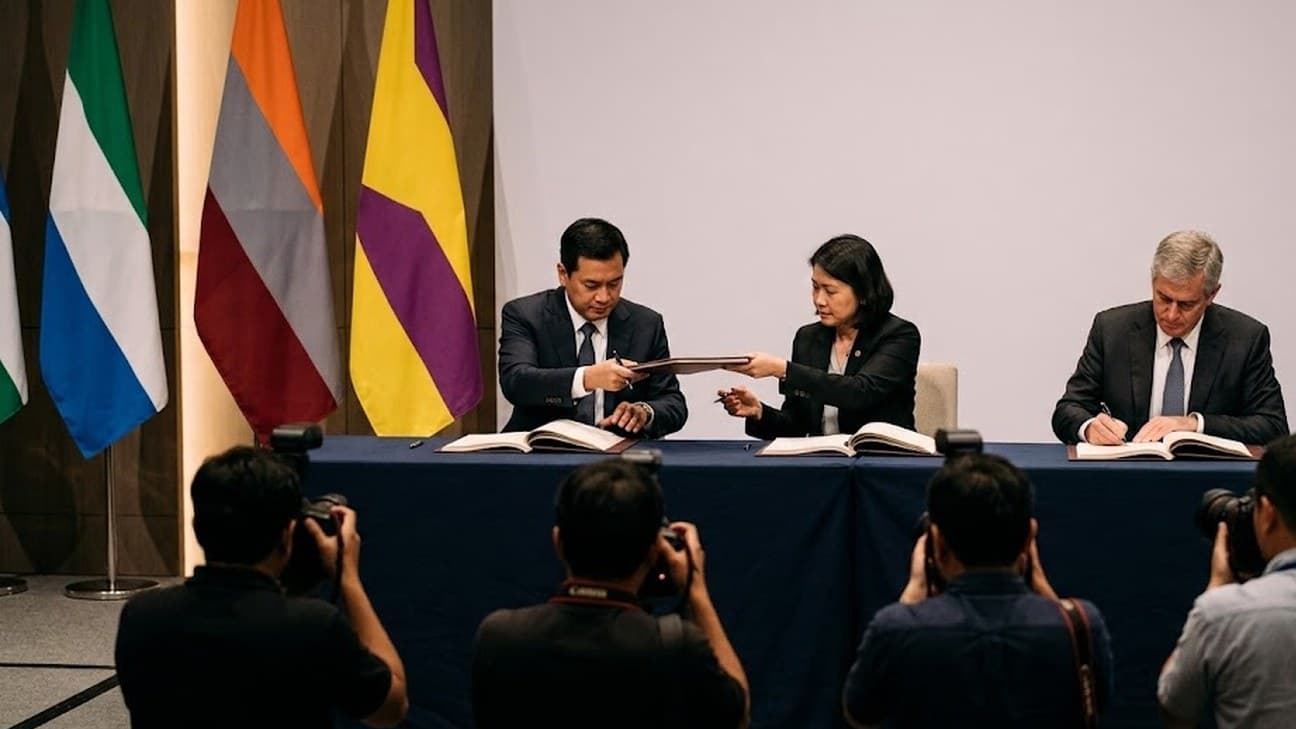
Wide editorial photograph of a formal signing ceremony in a conference room, ranked national flags to the left as three officials at a long table exchange and sign bound document folders, photographed from behind a row of press photographers raising their cameras toward the table.
A signing ceremony is the right visual register for a multi-country pact — the SoftBank-SC ZEUS-Robust HPC alliance is a formal agreement between named counterparties, not yet a built data centre.

SoftBank's Telecom Arm, Singapore's SC ZEUS and Malaysia's Robust HPC Sign a Four-Country AI Data-Centre Pact

SB Telecom Singapore, a SoftBank subsidiary, together with SC ZEUS Data Centers of Singapore and Malaysia's Robust HPC Group, signed an agreement effective 1 August 2026 to jointly develop AI data centres across Malaysia, Thailand, Indonesia and Vietnam. The division of labour is explicit: SC ZEUS handles land sourcing, design, build and operation; Robust HPC handles GPU cluster procurement, setup and management; and SB Telecom Singapore handles data hall fit-out, ICT integration, deployment support and connectivity. The specified infrastructure includes liquid cooling, 800 VDC architecture and low-latency networking.

The commercial model is aimed at AI Factory solutions, GPU-as-a-Service platforms and what the partners describe as "AI Token Factory" models. Hisao Inoue, Managing Director of SB Telecom Singapore, said the alliance "combines ICT connectivity, SC ZEUS's infrastructure capabilities, and Robust HPC's supercomputing expertise."

Grab's Financial Services Arm Grows Revenue 59% as Its Loan Book Triples Year-on-Year

Grab Financial Services reported second-quarter 2026 revenue of US$134 million, up 59% year-on-year. Loans disbursed reached US$1.2 billion, a 72% increase, and the gross loan portfolio expanded to US$2.3 billion from US$781 million. The segment's adjusted EBITDA loss narrowed to US$15 million from US$26 million. Deposits stood at US$2.5 billion across GXS Bank, GXBank and Superbank.

At group level, Grab reported revenue of US$997 million, up 22%, and profit of US$235 million, a figure that includes a US$307 million gain from consolidating Superbank. The company raised full-year 2026 revenue guidance to US$4.10-4.15 billion.

Malaysia Is the Only Asian Market Where Every Surveyed IT Decision-Maker Plans to Increase AI Spending

An Alibaba Cloud-commissioned NielsenIQ survey of 1,000 IT decision-makers across eight Asian markets found that 100% of Malaysian respondents plan to increase AI investment, with 97% raising spending on AI infrastructure and more than 90% investing further in platform and model services. Malaysia was the only market in the study to register unanimous intent.

Across the region, 99% of respondents said AI is a priority, 75% called it indispensable to operations and 90% have begun adopting AI development tools. The leading barriers were data privacy and security, cited by 48%, and high implementation costs, cited by 42%. Strategic objectives were led by innovation and new business at 64%, cost savings at 63% and revenue growth at 48%. Alibaba Cloud Intelligence Group CTO Dr Feifei Li said "The focus is shifting from producing efficient tokens to enabling actionable outcomes."

Eyes on the Day Ahead

The immediate watch items are siting and financing detail on the SoftBank-SC ZEUS-Robust HPC alliance: the agreement names four countries but no specific sites, power contracts or committed capacity, and those are the disclosures that would turn a memorandum into a project pipeline. On digital banking, Grab's Superbank consolidation gain means the next quarterly disclosure is the first clean read on the combined book, and any interim credit-quality commentary would be material. Over the next three to five days, watch for whether Malaysia's regulators or utilities respond to the domestic AI-demand data with anything concrete on power allocation — the constraint that has repeatedly bound the country's data-centre ambitions is grid capacity, not intent.

Layer 7 Ventures is a research-driven firm focused on AI and cryptocurrency in Southeast Asia. Views expressed are those of the firm and do not constitute investment advice.
More Research

A shopkeeper in a plaid shirt and a helmeted delivery rider face each other across the counter of a Kuala Lumpur shophouse in harsh midday sun, with a card payment terminal and stacked cartons on the counter and motorbikes parked at the kerb.
Daily Brief · FinTech · Geopolitics4 min

SEA Daily Brief: Malaysia Lifts SME Financing to RM57 Billion and Tops Up BNM's Relief Facility, Thailand Plans an SME Credit Portal, and Vietnam Wins Its First Investment-Grade Rating

Malaysia's Budget 2027 raises SME loan facilities and financing guarantees to RM57 billion from RM50 billion, while Bank Negara Malaysia adds RM5 billion to its SME Stabilisation Relief Facility after RM3.8 billion of the first tranche was approved. The Bank of Thailand outlined an SME credit portal, an alternative data exchange and a five-year guarantee scheme aimed at about 100 billion baht of new SME lending a year, after a four-year decline. Japan's R&I upgraded Vietnam to BBB-, the first investment-grade rating from an international agency, while Moody's, S&P Global and Fitch still rate it sub-investment grade.

High-angle view of a Kuala Lumpur financial district at pre-dawn blue hour, with office towers, a river bend and a few tiny pedestrians crossing a floodlit plaza and a marked crosswalk.
Daily Brief · FinTech · AI4 min

SEA Daily Brief: Malaysia's Budget 2027 Backs Startups and Crowdfunding, the SC Reports 2025 Restitution Figures, and UOB Explores a Dedicated AWS Cloud for ASEAN

Malaysia's Budget 2027, tabled on 9 October, earmarks RM450 million for startups through Jelawang Capital and Dana Perintis and RM270 million to draw private capital into equity crowdfunding and P2P platforms, with no distribution mechanism disclosed. The Securities Commission told Parliament it returned RM1.98 million to 239 investors in 2025 and has set aside RM8.6 million for 933 more. UOB signed an MoU with AWS to explore a dedicated Singapore cloud environment for its five ASEAN markets, with no financial terms or timeline given.

Office workers and a security guard walk across a stone forecourt toward a modern government building with a sweeping roofline in Kuala Lumpur, lit by low golden-hour sun with palm trees and a lawn in the foreground.
Daily Brief · FinTech · Crypto · AI4 min

SEA Daily Brief: Malaysia's Budget 2027 Proposes Tokenised Retail Sukuk, Singapore Licenses Large Data Centres, and the NSRC Plans an AI Scam-Check App

Prime Minister Anwar Ibrahim proposed a blockchain-based retail savings sukuk in Budget 2027, tabled on 9 October, with no launch date, minimum investment or return disclosed. Singapore's Parliament passed the Digital Infrastructure Bill on 7 October, creating licensing regimes for data centres of 10MW or more and large cloud providers. Malaysia's National Scam Response Centre also plans an AI application to check suspicious numbers, accounts and links, with no funding or launch date stated.

Stay Informed

Get the next report in your inbox.