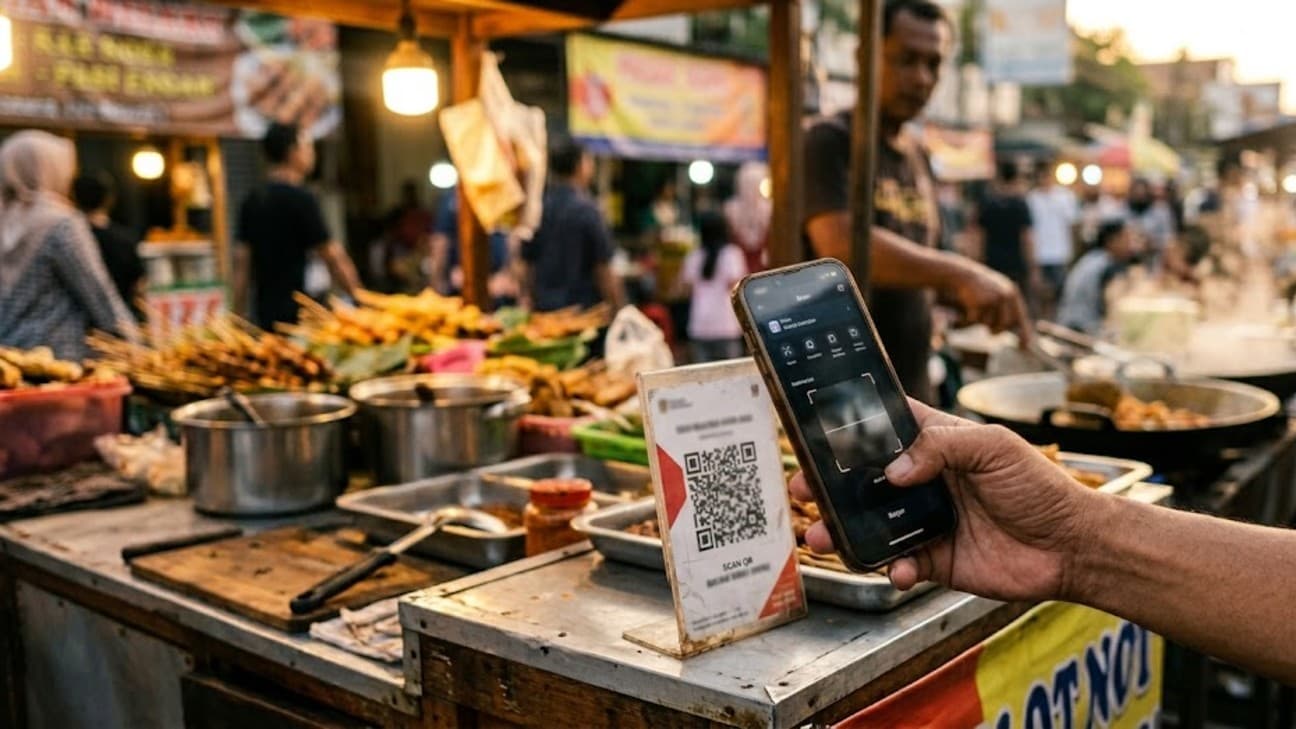
China Switches On a Nationwide Payment Rail Into Indonesia — and It Settles in Local Currency
On June 11, at the second governors' meeting of their joint work program in Shanghai, the People's Bank of China (PBOC) and Bank Indonesia announced the full launch of a two-way cross-border QR payment linkage with nationwide coverage. Chinese travellers can now pay with the UnionPay App, banking apps carrying UnionPay's MobileWallet Connect, and Alipay at QRIS merchants across Indonesia; Indonesian visitors can use QRIS-enabled banking and e-wallet apps — including MyBCA, OVO, DANA, GoPay, Mandiri and ShopeePay — at UnionPay and Alipay merchants in mainland China.
The scale numbers are the point. Chinese wallets can now reach more than 40 million QRIS merchants in Indonesia, most of them micro, small and medium enterprises, while Indonesian users can scan more than 80 million Alipay and UnionPay QR codes across China. The number of UnionPay QR merchants outside mainland China has passed 46 million, and payment networks in seven of the eleven ASEAN nations are now interoperable with UnionPay. Since the start of 2026, transactions by these wallets in China have doubled year-on-year, and QR payments made outside mainland China have surged more than 300% year-on-year.
Crucially, the linkage settles in local currency: an Indonesian's spending in China clears in renminbi, a Chinese visitor's spending in Indonesia clears in rupiah. That is the same design principle behind the ASEAN-led Project Nexus and the region's bilateral QR links (DuitNow, PromptPay, QRIS, PayNow), but here the network and the settlement plumbing are China's, not a multilateral hub's. The headline framing is tourist convenience; the substance is two of Asia's largest payment networks acquiring distribution and transaction data in the region's biggest consumer market.
Crypto Companies Enter the Fortune Southeast Asia 500 for the First Time — and They Are Miners, Not Exchanges
Fortune unveiled its 2026 Southeast Asia 500 on June 16, the third edition of its ranking of the region's largest companies by revenue. For the first time, the list includes crypto businesses: Bitdeer Technologies Group entered at No. 401 with US$620.3 million in fiscal-2025 revenue, and BitFuFu at No. 475 with US$477.5 million. Both are Singapore-based, and both are crypto-mining firms — the first such companies ever to clear the cut.
The bar they cleared is high and rising. The revenue threshold for inclusion climbed to US$440.6 million, 26% above the prior year. Collectively the 500 companies generated US$1.878 trillion in revenue for fiscal 2025, up 3.4%, with combined profits of US$150.0 billion. Singapore-headquartered commodity trader Trafigura topped the list for a third straight year at US$240.3 billion. Vietnam was the standout national cohort: its 72 ranked companies posted US$177.9 billion in aggregate revenue, up 10.5% — triple the regional average, and about a quarter of the entire list's revenue growth.
What matters is the kind of crypto firm that made it. These are not exchanges riding trading fees but capital-intensive mining and compute operators — the part of the digital-asset stack that owns hardware, power contracts and data-centre capacity. That places them on the same infrastructure curve as the AI build-out, and both Bitdeer and BitFuFu have been steering hashpower-grade facilities toward high-performance and AI hosting. Singapore being the headquarters of record for the region's first listed crypto entrants is its own quiet signal about where the sector domiciles.
Vietnam's Licensed-Exchange Pilot Moves Closer — on Terms That Hand the Market to Incumbents
Vietnam's regulated crypto market is the region's most consequential digital-asset opening still in motion, and the past weeks have sharpened its terms. Under Government Resolution 05/2025/NQ-CP and the Digital Technology Industry Law that took effect on January 1, 2026, the country is running a five-year pilot for licensed crypto-asset trading platforms. A Finance Ministry document dated March 12 confirmed that five applicants cleared initial screening — affiliates of Techcombank, VPBank, LPBank, VIX Securities and the Sun Group conglomerate — and a prime-ministerial directive targets a launch in the second quarter, now closing this month.
The entry terms are steep by design. A licensed service provider must hold a minimum paid-in charter capital of VND10 trillion (about US$381 million), contributed in dong; at least 65% of that capital must come from institutional investors, of which more than 35% must be supplied by at least two institutions such as commercial banks, securities firms, fund managers, insurers or technology companies. Speaking on June 6, State Securities Commission vice chairman Bùi Hoàng Hải said all trading will be denominated in Vietnamese dong — including transactions in Bitcoin, Ether and stablecoins such as USDT and USDC — that foreign investors may open accounts and participate, and that domestic access will initially be limited to investors who already hold crypto.
The strategic logic is capital-flow control. Vietnam moved an estimated US$200 billion in crypto in the year through June 2025 and ranks among the top markets globally for both user numbers and adoption; Hanoi is moving to channel that activity onto licensed onshore venues while restricting access to offshore platforms such as Binance, OKX and Bybit. Officials project the country's tokenised-asset market could reach US$70–80 billion by 2030. Layer 7's June 11 weekly flagged this pilot as the regulatory thread to watch; the question has now shifted from intent to execution, and to whether a first licence lands before the quarter ends or slips into the third.
Eyes on the Week Ahead
Vietnam's pilot is the near-term catalyst: the prime minister's Q2 launch window closes this month, so watch for either a first licence award to one of the five shortlisted bank- and conglomerate-backed applicants or a public slip into Q3 — the latter would signal that the technical-readiness and capital bar is biting harder than the timeline implied. In Thailand, the SEC's spot Bitcoin and Ether ETFs remain targeted for the third quarter, alongside work with the Bank of Thailand on stablecoins, deposit tokens and tokenised-fund settlement; any concrete rule or launch date would put Thailand alongside Singapore as a live regulated venue for tokenised products.
On the payments front, the China–Indonesia QR link raises the question of which corridor extends next. With UnionPay already interoperable across seven of eleven ASEAN markets, watch whether Malaysia (DuitNow) or Thailand (PromptPay) deepen the same two-way, local-currency model — and how that sits against the ASEAN-led Project Nexus, which is targeting live multilateral connectivity in 2026. Separately, Bank Negara Malaysia has guided that it intends to provide clearer policy direction on ringgit stablecoins and tokenised deposits by the end of 2026, the next domestic milestone in the region's tokenisation race.
Layer 7 Ventures is a research-driven firm focused on AI and cryptocurrency in Southeast Asia. Views expressed are those of the firm and do not constitute investment advice.