The Grid Becomes the Binding Constraint on Southeast Asia's AI Build-Out
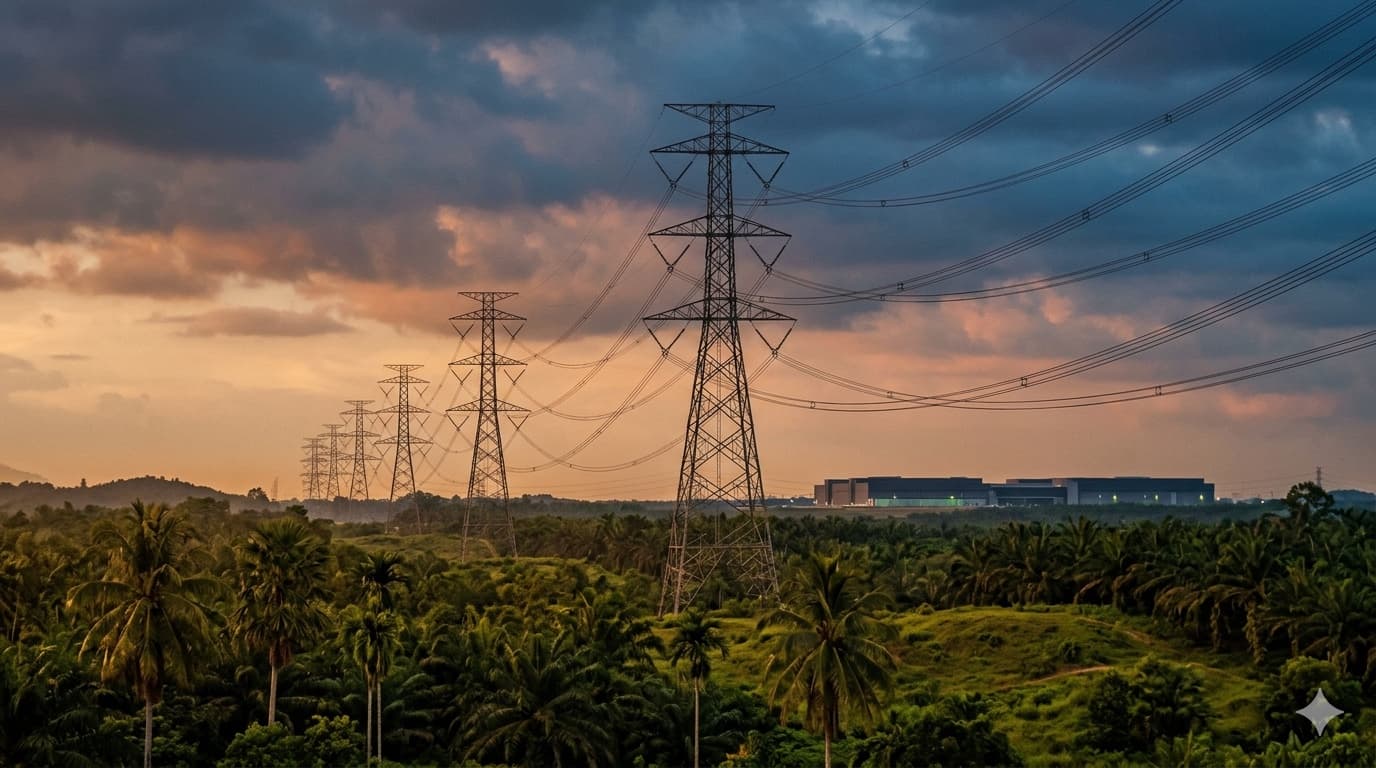
The week's loudest data-centre news was a number: 1.2 gigawatts, the power commitment Singapore-based BDx secured from Indonesia's state utility PLN, the largest single data-centre power deal in the country's history. But the more consequential development was an argument, not a deal. In a June 1 analysis, TNGlobal made the case that grid readiness — not land cost, not tax incentives, not even capital availability — has become the variable that determines which Southeast Asian AI projects are actually feasible. Six major ASEAN economies already have roughly 2.9 GW of data-centre capacity in their development pipelines, and green industrial parks, data centres and EVs together could lift regional power demand by more than 100 terawatt-hours within three to four years. Globally, data centres alone are projected to consume around 945 TWh by 2030, up from 415 TWh in 2024.
The financing gap is the part investors are underpricing. TNGlobal cited an estimated US$18 billion annual shortfall in grid investment across Southeast Asia by 2035, with the broader power-and-grid build-out potentially requiring more than US$200 billion. Vietnam, Thailand and Indonesia have each cancelled renewable projects over the past five years, leaving the region short of the firm, dispatchable capacity that hyperscale tenants demand. The result is an inversion of the old site-selection logic: a developer can raise capital and sign tenants, but if the substation, the gas terminal and the water supply are not there, the project stalls. Power procurement capacity — not the data hall — is now the long-lead item.
Malaysia is where this constraint is most visible, because the country has simultaneously become ASEAN's fastest-growing data-centre hub and run headlong into its own grid limits. Tenaga Nasional's RP4 tariff framework, in force from July 2025 through December 2026, raised the Peninsular Malaysia base tariff from 39.96 sen to 45.62 sen per kWh — roughly a 14 percent increase — and restructured pricing onto a voltage-based model that explicitly loads higher network and capacity charges onto heavy industrial users such as data centres. The government has paused approvals for non-AI-driven data centres, citing power and water constraints, while a June 3 commentary in the Malay Mail argued bluntly that Malaysia's AI ambitions will be decided 'not in Putrajaya, but in substations, gas terminals and rivers.' Malaysia's electricity demand could rise by 59 TWh by 2030 — equivalent to the Philippines' entire annual consumption — against a generation mix still more than 75 percent reliant on coal and gas.
Into that gap has stepped China. A March analysis documented how Chinese firms are now financing and equipping the Malaysian grid the data-centre boom depends on: DayOne (the international arm formerly under GDS) invested US$3.5 billion in Johor, PowerChina is building gas and hydropower capacity, Huawei is supplying smart-grid upgrades, and Tianneng Group announced a 1 GWh integrated solar-storage-computing project. The pattern is that the same Chinese ecosystem supplying data-centre capacity is also supplying the power infrastructure to run it — a vertical bundle that local utilities and Western financiers have been slower to assemble.
Sources
- TNGlobal — Why grid readiness is becoming Southeast Asia's next tech constraint
- China Global South Project — China Steps In as Malaysia's Data Center Surge Puts the Power Grid to the Test
- W.Media — Data centers in Malaysia brace for higher electricity bills (TNB RP4 tariff)
- TNGlobal — BDx secures 1.2 GW of power in Indonesia with state utility PLN (covered in the daily brief, cited here for the demand-side timeline)
Malaysia Resets Its Digital-Asset Market for Institutional Scale
On May 20, the Securities Commission Malaysia's revised Guidelines on Recognized Markets for digital asset exchanges took effect — a quieter development than the week's data-centre numbers, but one that resets the operating environment for every licensed crypto venue in the country. The framework pairs two moves that usually pull in opposite directions: it streamlines the approval process so licensed DAX operators can launch new products faster, while simultaneously raising the bar on governance, financial soundness, management competency and client-asset safeguards. SC Chairman Mohammad Faiz Azmi framed the intent directly, saying the digital-asset industry 'must mature alongside the broader capital market ecosystem.'
The investor-protection scaffolding is the substantive part. All DAX operators will become members of the Financial Markets Ombudsman Service during 2026, giving retail investors a formal dispute-resolution channel for the first time, and the SC has updated its exchange-traded fund guidelines to permit digital-currency ETFs — bringing crypto exposure inside a familiar, regulated wrapper rather than leaving it to offshore platforms. On the enforcement side, the regulator has taken administrative action against four exchanges operating without registration and, from April 14, began working with technology firms including Google to block unregistered DAX operators from advertising to Malaysians across social and online channels.
The market data explains why the SC is formalising now rather than later. Total trading value on Malaysia's licensed DAX platforms reached RM17.14 billion in 2025, a 23 percent jump from RM13.93 billion in 2024 — growth that is increasingly institutional in character. The revised guidelines are explicitly tied to the Capital Market Masterplan 2026–2030, which targets expanding Malaysia's total capital-market size to between RM5.8 trillion and RM6.3 trillion by 2030. Malaysia currently licenses a small set of DAX operators — Luno, Tokenize and SINEGY among them, with newer entrants such as Hata expanding the field — and the new rules are designed to let that licensed cohort compete on product velocity while the unlicensed perimeter is squeezed.
Sovereign Capital Bets on Malaysia's Homegrown Silicon
The third constraint Malaysia is trying to solve is capital for the high-value end of the chip supply chain — and the clearest evidence arrived in how aggressively the country's sovereign institutions backed SkyeChip, the first Malaysian chip-design house to list on Bursa Malaysia's Main Market. SkyeChip raised RM352 million in its IPO, the largest Malaysian listing in 16 years, with the institutional tranche oversubscribed roughly 95 times. The stock opened at RM3.50 against an 88-sen offer price — nearly four times its IPO — before settling at RM2.21 on debut, leaving it with a market capitalisation of around RM3.97 billion. SkyeChip designs silicon IP and custom ASICs rather than fabricating chips; its memory-interface IP business, central to AI infrastructure, grew more than 500 percent over the FY2023–FY2025 period, and full-year net profit rose to RM48.54 million.
What makes the listing a policy signal rather than just a hot IPO is the cap table. Twenty-two cornerstone investors took up close to 60 percent of the institutional tranche, and the roster reads like a roll-call of Malaysian state capital: the Employees Provident Fund, Khazanah Nasional (via Pantai Feringgi Ventures), the Armed Forces Fund Board (LTAT) and the Pilgrims' Fund Board (Tabung Haji). That is the sovereign and quasi-sovereign balance sheet of Malaysia anchoring a homegrown semiconductor champion at scale — and it lands the same week the daily brief tracked Prime Minister Anwar Ibrahim's call, at a Securities Commission forum, for government-linked companies to accept calculated losses on AI and digital ventures rather than sit out the cycle. The SkyeChip book is what that policy looks like in practice.
SkyeChip is also the design anchor of a broader industrial bet. It is one of five founding members of the Malaysia Advanced Packaging Consortium (MAPC) — alongside Inari, Pentamaster, NSW Automation and startup FusionAP — which received RM92 million in government R&D grants through the Malaysia Science Endowment, matched by RM93.8 million in industry contributions for a combined RM185.8 million over 24 months. The consortium's target is to capture 7 percent of the global advanced-packaging market by 2035, a segment carrying gross margins of 40 to 50 percent versus the thin economics of traditional assembly and testing, with the prize estimated at around US$5 billion annually. SkyeChip's specific remit is high-bandwidth-memory design and 2.5D/3D chiplet architecture.
Eyes on the Week Ahead
On the power thread, watch for any further Indonesian or Malaysian PLN/TNB power-purchase agreements following the BDx 1.2 GW deal — the cadence of firm-power commitments, not data-centre groundbreakings, is the leading indicator of which projects clear. In Malaysia specifically, any movement on lifting or refining the non-AI data-centre pause, or new detail on grid capex under the RP4 regime, would signal how the government intends to reconcile its AI hub ambitions with a coal-and-gas-heavy generation mix. Chinese grid-and-compute bundle announcements in Johor and Batam are worth tracking for the concentration risk they imply.
On digital assets, the operative question is which licensed Malaysian DAX operators move first to file digital-currency ETF products or institutional custody offerings under the SC's faster approval lane — the first such application will test whether the streamlined process is real. In Vietnam, no exchange has yet been licensed under the five-exchange pilot regime despite earlier qualification rounds; a named first grant would reset the regional exchange map. And on semiconductors, watch for follow-on MAPC disclosures and any secondary placements or analyst initiations on SkyeChip now that the stock has settled below its opening print — the gap between the IPO euphoria and delivered advanced-packaging milestones is the number that matters over the next several quarters.
Layer 7 Ventures is a research-driven firm focused on AI and cryptocurrency in Southeast Asia. Views expressed are those of the firm and do not constitute investment advice.