All reports
Daily Brief · FinTech · Crypto · AI

Franklin Templeton's BENJI lands on MAS-licensed DigiFT, Malaysia's AI banking skills gap, and ATxE 2026's enterprise pivot

Franklin Templeton brought its tokenized US Treasury platform to Asia through Singapore-regulated DigiFT, opening institutional rails for accredited investors. Malaysia's chartered banker body credentialed more than 700 professionals as new survey data showed AI capability is outpacing workforce readiness. Asia Tech x Enterprise 2026 logged 120,000 business interactions in Singapore, signalling the region's shift from AI experimentation to enterprise deployment.

May 27, 20264 min readSingapore · Malaysia · Tokenization · Stablecoins · AI · MAS · Bank Negara Malaysia · Franklin Templeton · DigiFT
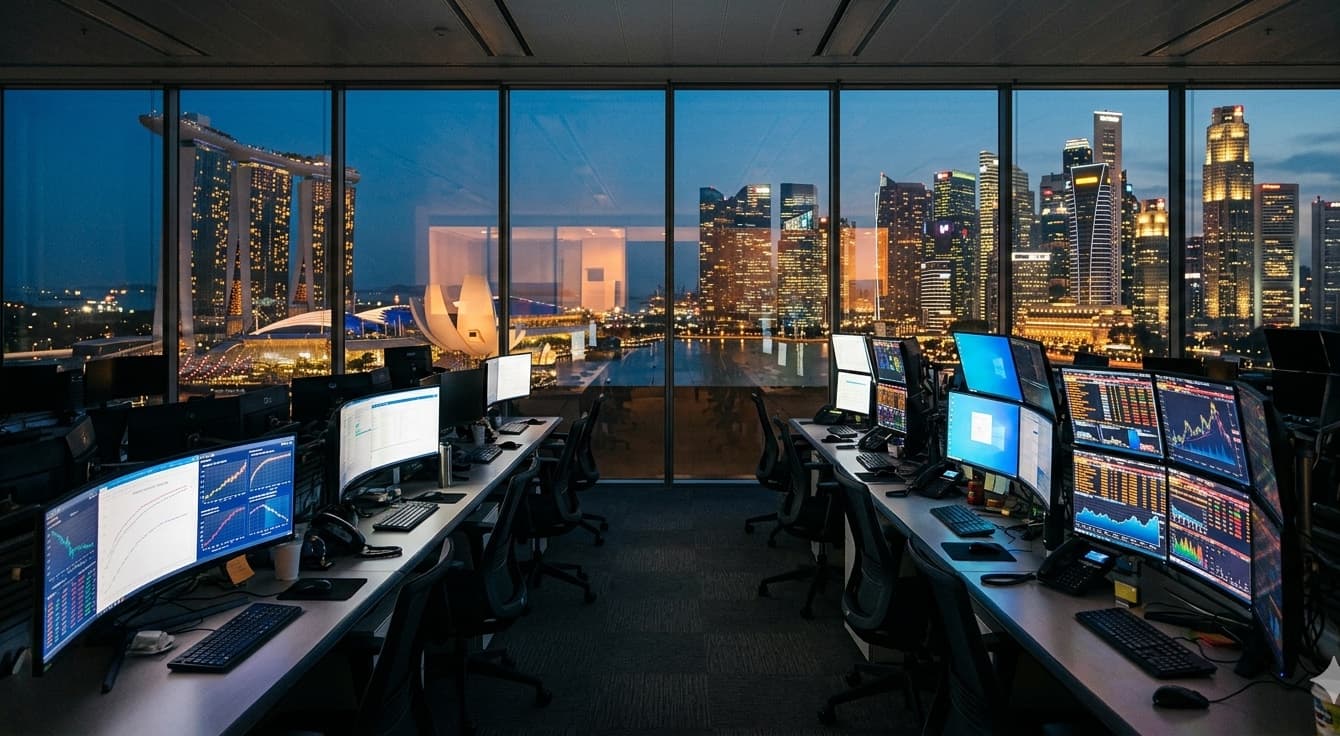
Two analysts at multi-monitor trading desks in Singapore at dusk, facing a glass wall that frames the Marina Bay financial district skyline lit gold and blue at twilight
Singapore's institutional tokenization stack moves from pilot to product as Franklin Templeton's BENJI platform lists on MAS-licensed DigiFT.

Franklin Templeton Brings BENJI Tokenized Treasury Rails to Asia via MAS-Licensed DigiFT

Franklin Templeton and DigiFT announced a long-term strategic partnership on May 20, 2026 to make the BENJI Technology Platform and its tokenization products available to accredited and institutional investors across Asia. Franklin Templeton manages approximately US$1.74 trillion in assets; DigiFT holds Capital Markets Services and Recognised Market Operator licences from the Monetary Authority of Singapore, and Type 1 and Type 4 licences from Hong Kong's Securities and Futures Commission.

BENJI tokenizes US government securities strategies with a patent-pending intraday yield mechanism that accrues continuously, alongside 24/7 transferability between permissioned wallets and near-instant on-chain settlement. The pitch is institutional treasury, payments collateral and on-chain settlement, not retail speculation. The partnership announcement framed the macro tailwind: tokenized real-world assets on public blockchains expanded from US$5.5 billion to US$18.6 billion across 2025, with tokenized US Treasuries the dominant institutional category.

AICB Credentials 700+ Bankers as Malaysia's 2025 Survey Shows Tech Outrunning Workforce Capability

The Asian Institute of Chartered Bankers (AICB) held its 9th Chartered Banker Conferment Ceremony at the Kuala Lumpur Convention Centre on May 22, 2026, conferring Fellow Chartered Banker status on seven senior executives, Chartered Banker status on 114 members, and recognising 611 Associate Chartered Bankers. Cohorts came from Malaysia, Cambodia, the Maldives and the Philippines — AICB is positioning itself as a regional credential, not a domestic one.

The accompanying AICB 2025 Workforce Survey is the data point investors should mark: 57% of financial institutions surveyed are still in the early stages of AI adoption, and 62% identified technology outpacing workforce capability as their primary barrier to progress. Maybank — currently mid-way through a RM10 billion technology and AI investment programme to 2030 — was recognised for producing the highest number of new Chartered Bankers in 2025.

ATxE 2026 in Singapore Signals Southeast Asia's Shift From AI Experimentation to Enterprise Deployment

Asia Tech x Enterprise (ATxE) 2026, jointly organised by Singapore's Infocomm Media Development Authority and Informa Festivals, wrapped at Singapore EXPO during the week of May 20–22 with over 120,000 business interactions, 450-plus speakers and 700-plus exhibitors across 35 pavilions. The event director's framing was explicit: the regional conversation has moved from whether to adopt AI to how to scale it responsibly across enterprise and government.

Sector-level demand told the same story. VIP buyer attendance from supply chain, logistics and transport rose 500% year-on-year; healthcare and pharma rose 320%; retail and FMCG rose 80%. Singapore used the event to launch the AI for Enterprise Impact Playbook drawn from over 1,000 enterprise insights, the Digital Enterprise Blueprint for SME support, and the inaugural SME AI Impact Awards 2026 — all aimed squarely at SME-tier adoption rather than hyperscaler workloads.

Eyes on the Day Ahead

Three threads to track in the next 24–72 hours: (1) whether any other MAS-licensed RMO follows DigiFT in announcing a US asset-manager tokenization tie-up — Franklin Templeton's BENJI distribution is unlikely to stay exclusive for long; (2) Bank Negara Malaysia's next move on the Digital Asset Innovation Hub now that the workforce survey has publicly framed AI as a skills problem rather than a capex one; (3) follow-on commentary from ATxE plenaries on Singapore's Digital Enterprise Blueprint — the SME-tier policy detail is where actual deal flow will land.

Layer 7 Ventures is a research-driven firm focused on AI and cryptocurrency in Southeast Asia. Views expressed are those of the firm and do not constitute investment advice.

More Research

A shopkeeper in a plaid shirt and a helmeted delivery rider face each other across the counter of a Kuala Lumpur shophouse in harsh midday sun, with a card payment terminal and stacked cartons on the counter and motorbikes parked at the kerb.
Daily Brief · FinTech · Geopolitics4 min

SEA Daily Brief: Malaysia Lifts SME Financing to RM57 Billion and Tops Up BNM's Relief Facility, Thailand Plans an SME Credit Portal, and Vietnam Wins Its First Investment-Grade Rating

Malaysia's Budget 2027 raises SME loan facilities and financing guarantees to RM57 billion from RM50 billion, while Bank Negara Malaysia adds RM5 billion to its SME Stabilisation Relief Facility after RM3.8 billion of the first tranche was approved. The Bank of Thailand outlined an SME credit portal, an alternative data exchange and a five-year guarantee scheme aimed at about 100 billion baht of new SME lending a year, after a four-year decline. Japan's R&I upgraded Vietnam to BBB-, the first investment-grade rating from an international agency, while Moody's, S&P Global and Fitch still rate it sub-investment grade.

High-angle view of a Kuala Lumpur financial district at pre-dawn blue hour, with office towers, a river bend and a few tiny pedestrians crossing a floodlit plaza and a marked crosswalk.
Daily Brief · FinTech · AI4 min

SEA Daily Brief: Malaysia's Budget 2027 Backs Startups and Crowdfunding, the SC Reports 2025 Restitution Figures, and UOB Explores a Dedicated AWS Cloud for ASEAN

Malaysia's Budget 2027, tabled on 9 October, earmarks RM450 million for startups through Jelawang Capital and Dana Perintis and RM270 million to draw private capital into equity crowdfunding and P2P platforms, with no distribution mechanism disclosed. The Securities Commission told Parliament it returned RM1.98 million to 239 investors in 2025 and has set aside RM8.6 million for 933 more. UOB signed an MoU with AWS to explore a dedicated Singapore cloud environment for its five ASEAN markets, with no financial terms or timeline given.

Office workers and a security guard walk across a stone forecourt toward a modern government building with a sweeping roofline in Kuala Lumpur, lit by low golden-hour sun with palm trees and a lawn in the foreground.
Daily Brief · FinTech · Crypto · AI4 min

SEA Daily Brief: Malaysia's Budget 2027 Proposes Tokenised Retail Sukuk, Singapore Licenses Large Data Centres, and the NSRC Plans an AI Scam-Check App

Prime Minister Anwar Ibrahim proposed a blockchain-based retail savings sukuk in Budget 2027, tabled on 9 October, with no launch date, minimum investment or return disclosed. Singapore's Parliament passed the Digital Infrastructure Bill on 7 October, creating licensing regimes for data centres of 10MW or more and large cloud providers. Malaysia's National Scam Response Centre also plans an AI application to check suspicious numbers, accounts and links, with no funding or launch date stated.

Stay Informed

Get the next report in your inbox.